New Construction on Key Biscayne: What Actually Exists in 2026
New construction on Key Biscayne, what actually exists, is a short list. There is no builder putting up a new condo tower this year. There is no master-planned community with a sales trailer and a list of floor plans. What exists is a small, steady stream of custom single-family rebuilds on lots that already had a house on them, one true new-construction condo tower that delivered back in 2016, and a slow-moving question mark hanging over some of the island’s older buildings because of what happened next door in Surfside. That’s it. If you’re searching for “new construction on Key Biscayne” expecting something like what’s happening in Doral or Cutler Bay right now, you’re going to be disappointed, and it’s better to know that before you start looking than after.
This guide breaks down exactly what “new” means on Key Biscayne today, why the island works so differently from the mainland, and what a buyer who wants something new should realistically expect to find and pay for.
Why Key Biscayne Can’t Build Like the Mainland
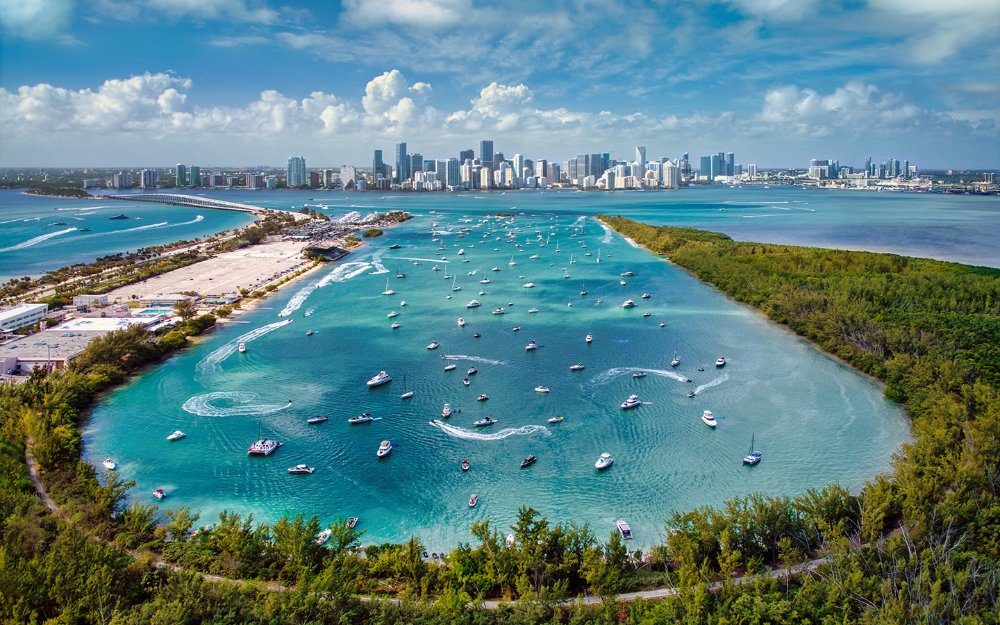
Key Biscayne is a barrier island connected to the mainland by a single road, the Rickenbacker Causeway, with a toll booth at the base. It is bounded on the south end by Bill Baggs Cape Florida State Park and on the north end by Crandon Park, both of which are permanently protected and will never be developed. In between is roughly two square miles of land that has been essentially built out since the 1980s and 90s.
The Village of Key Biscayne incorporated in 1991, which means the island controls its own zoning and building codes rather than deferring to Miami-Dade County. Since incorporation, the Village has kept height limits and density tight, capping most residential and mixed-use districts well below what’s allowed a few miles away across the causeway. There is no appetite, from the Village Council or from residents, to allow the kind of high-rise building boom that has reshaped Edgewater, Brickell, or Downtown Miami over the last decade, where towers now regularly clear 400 and 500 feet. Key Biscayne residents largely moved there, or stayed there, specifically because it doesn’t look like that.
The contrast is easier to see side by side. In Doral, a builder like Lennar can bring 500 units online at Urbana at Downtown Doral or another 400 at Park Central Doral, priced from the $380,000s into the $1 million range, because there’s open land, a growth-friendly zoning code, and county government eager to add tax base. In Cutler Bay, Century Homebuilders and D.R. Horton are actively selling new single-family homes in the $930,000 to $1 million range on land that was undeveloped a decade ago. None of that exists as an option on Key Biscayne, not because demand is lower (it isn’t) but because there’s no vacant land to build on and no local government interested in changing that.
Put those two facts together, no vacant land and a local government that limits height and density on purpose, and you get a real estate market where “new construction” almost never means a new site. It means a new building on an old site.
If you want the fuller picture of how the island is laid out and what living there actually involves, the complete guide to Key Biscayne for buyers considering the island covers the geography, the commute, and the tradeoffs in more depth than this piece will.
New Construction on Key Biscayne: What Actually Exists Today
Here’s the honest inventory, broken into the three categories that cover essentially everything a buyer will encounter.
1. Single-family teardown rebuilds
This is the overwhelming majority of what qualifies as “new construction” on the island in any given year. A buyer, an investor, or a local custom builder purchases an older home, usually a 1960s to 1980s ranch or two-story house on a canal or interior lot, demolishes it, and builds a new home from the ground up on the same footprint. The lot doesn’t change. The address doesn’t change. But the structure is brand new, built to current wind and flood codes, often with a higher elevation than the home it replaced.
2. One condo tower, delivered in 2016
Oceana Key Biscayne, developed by Terra Group on the oceanfront along Ocean Drive, is the last true ground-up new construction condo the island has seen. It delivered in 2016 with 49 oceanfront residences. It was, and still is, treated as the newest luxury condo product on Key Biscayne, because nothing has replaced it. When buyers ask agents for “new construction condos on Key Biscayne,” Oceana resales are functionally the answer, since there is no newer building to point to.
3. Aging condo stock that may eventually get rebuilt
Most of Key Biscayne’s condo towers along Crandon Boulevard and Ocean Drive went up during the island’s main building era, roughly the 1970s through the early 1990s. Those buildings are now 30 to 50 years old. Under Florida’s post-Surfside condo safety laws, they’re required to complete milestone structural inspections and fund full reserves rather than waive them. For a handful of the oldest, smallest, or most functionally obsolete buildings, that math doesn’t work, and the more realistic outcome is a unit owner buyout and a full condo termination that clears the site for a new building. Nothing like that has closed on Key Biscayne yet as of this writing, but it’s the one legitimate path to a second new condo tower on the island, and it’s worth understanding even though it isn’t a place to put money today. More on that below.
Single-Family Teardown Rebuilds: The Real New Construction
If you want a truly new structure on Key Biscayne, the teardown-rebuild is the path, and it happens most often in a handful of areas.
Mashta Island
Mashta Island is a small, gated sub-island connected to the main body of Key Biscayne by a private bridge, and it’s the most exclusive address on the island. Lots here are large by Key Biscayne standards, waterfront, and command some of the highest per-square-foot land values in Miami-Dade. When a rebuild happens on Mashta, it’s typically a full custom home in the $8 million to $20 million-plus finished range, built by high-end local custom builders rather than a production homebuilder.
The canal-front streets off Crandon Boulevard
Streets like Fernwood, Glenridge, Harbor Drive, and Point View Drive make up the bulk of Key Biscayne’s single-family stock. These lots run smaller than Mashta Island but still waterfront or near-waterfront, and this is where most of the island’s actual teardown activity happens year to year. A buyer here is typically purchasing an older home specifically to demolish it, then spending 18 to 30 months on permitting and construction. All-in costs (land plus build) commonly land in the $4 million to $8 million range depending on lot size, waterfront access, and finish level, though it varies widely.
What a teardown actually looks like, start to finish
Walk through a realistic version of this. A family relocating from the Northeast buys an existing 1970s three-bedroom ranch on Glenridge for $3.2 million, not because they want the house, but because they want the lot. They hire a local architect familiar with Village review, submit for demolition and new construction permits, and wait. Village staff review takes longer than most mainland municipalities because every plan gets checked against the island’s flood elevation requirements on top of standard Miami-Dade High Velocity Hurricane Zone code, which mandates impact windows and doors, reinforced roof-to-wall connections, and wind loads rated for sustained hurricane-force gusts. Add in a new elevation certificate, since FEMA base flood elevations on the island have been revised upward since most of these homes were originally built, and the new house typically sits several feet higher than the one it replaced.
Demolition and site work take a few months. Vertical construction on a custom 5,000 to 7,000 square foot home runs another 12 to 18 months with a good local builder, longer if there are delays in material delivery or subcontractor scheduling, both of which are more common on a barrier island where every crew has to cross the causeway with a toll and often sits in beach traffic to get there. All-in, that family is looking at roughly $5 million in construction on top of the $3.2 million lot, and a two-year runway before they move a single box into the house.
What buyers should know before pursuing this route
Key Biscayne’s permitting process is not fast. Between Village review, FEMA flood elevation requirements, and the general slowdown that comes with building on a barrier island where every contractor and subcontractor also has to cross the causeway, a rebuild timeline of two years from purchase to certificate of occupancy is normal, not a delay. Buyers coming from mainland new-construction communities where a builder hands over keys in eight months need to reset that expectation entirely.
It’s also worth knowing that not every existing home on the island is a candidate for this. Homes on smaller interior lots without water access can still be rebuilt, but the finished value ceiling is lower, which changes the math on whether a full teardown makes sense versus a major renovation. A good local builder or agent who’s walked several of these projects through Village review can tell you within a few minutes of looking at a lot whether a teardown pencils out or whether renovation is the smarter play.
For buyers trying to figure out where on the island this kind of project (or any purchase) makes sense, where to live on Key Biscayne, covering condos, single-family, and bayfront breaks down the sub-areas in more detail.
Oceana and the Last Wave of Condo Development
Oceana Key Biscayne deserves its own section because it’s genuinely the reference point for “new” on the island. Built oceanfront on Ocean Drive, it delivered full-building amenities that didn’t exist in the older 1970s and 80s towers nearby: a private beach club feel, larger floor plates, higher-end finishes, and modern engineering and hurricane protection standards.
Unit sizes at Oceana run large by South Florida condo standards, with residences ranging from roughly 2,700 square feet for the smaller three-bedroom layouts up to 8,000-plus square feet for the penthouse collection, most with wraparound terraces built for ocean views rather than an afterthought balcony bolted onto the side of the building. The building was designed with only 49 units across the entire tower, which is a fraction of what a comparable oceanfront site in Sunny Isles or Fort Lauderdale would typically hold. That low density was intentional, and it’s part of why resale demand has stayed strong even nearly a decade after delivery.
Resale pricing at Oceana today reflects that gap. Units that traded in the $3 million to $6 million range at initial delivery now transact well above that, with larger residences and penthouses reaching into the eight figures. There is no new inventory being released there. Every Oceana transaction on Key Biscayne now is a resale, which is an important distinction for buyers who assume “new construction condo” means buying from a developer with incentives, upgrade credits, or a choice of finishes. On Key Biscayne, that buyer experience doesn’t exist anymore. You’re buying a nine-year-old building on the resale market and negotiating with an individual seller, not a sales center.
That also means the negotiating dynamics are different. There’s no developer contract with standardized terms, no deposit schedule tied to construction milestones, and no ability to select finishes before closing. You’re underwriting a specific unit, a specific line, a specific view, and a specific seller’s motivation, the same as any resale transaction, just at a higher price point than most of the island’s other condo stock.
For buyers specifically weighing whether Oceana or the rest of the island’s luxury stock is worth the premium, Key Biscayne luxury real estate and what the premium market actually looks like goes deeper on pricing and positioning across the top of the market.
The Post-Surfside Wildcard: Aging Condos and Redevelopment Risk
It’s impossible to talk honestly about future new construction on Key Biscayne without addressing Surfside. Champlain Towers South, the building that partially collapsed in June 2021, sits just north of Key Biscayne along the same barrier island chain. That collapse rewrote condo law statewide.
Florida’s SB 4D and the follow-up legislation now require milestone structural inspections at 30 years (25 in some coastal counties) and mandate that condo associations fully fund structural reserves rather than vote to waive or underfund them, which had been common practice for decades. For a well-maintained, financially healthy building, this mostly means higher HOA dues and a real reserve account. For an older, smaller, or structurally troubled building, it can mean special assessments large enough that owners start asking whether it makes more financial sense to sell the entire building to a developer and split the proceeds, a process known as condo termination.
This is exactly the mechanism that has produced new construction sites in other aging South Florida condo markets over the last few years. Coastal towns up and down the Miami-Dade and Broward oceanfront have seen small, older buildings quietly assembled by developers who buy out enough owners to force a termination vote, then clear the site for something larger and newer. On Key Biscayne specifically, no termination and rebuild has closed as of now, but several of the island’s older, smaller towers are the kind of asset (small unit count, aging systems, valuable land under a modest structure) that eventually goes this route somewhere in South Florida. Buyers should treat this as a market dynamic to watch, not a current opportunity to bet on. If it happens, it will likely start with an owner vote and a developer offer, not a construction permit, and that process alone typically takes years.
What makes Key Biscayne different from some of those other coastal markets is scarcity working in the opposite direction. There’s almost no land left on the island at all, which means any building that does eventually terminate and get rebuilt would command a premium simply because there’s nowhere else on Key Biscayne to build it. That cuts both ways for current owners in an older building. It’s a reason to expect a strong buyout offer if a termination ever gets proposed, and it’s also a reason developers move slowly and carefully here rather than rushing, since a mistake on one of the island’s few remaining sites is expensive to fix.
If you’re considering an older Key Biscayne condo purchase and want to understand how reserve requirements affect what you’re actually buying, that’s worth a direct conversation before you write an offer, since the HOA financials tell you more about the building’s future than the listing photos do. Ask for the most recent milestone inspection report, the current reserve study, and at least two years of board meeting minutes before you get attached to a unit. That paperwork will tell you whether you’re buying into a building with a clear, funded maintenance plan or one that’s a few years from a hard assessment conversation.
What “New” Actually Costs on Key Biscayne
To put real numbers around this, here’s how the options stack up for a buyer who specifically wants something new or newer, not just an existing home.
A teardown-rebuild lot plus construction: Commonly $4 million to $8 million all-in on the canal-front streets, and $8 million to $20 million-plus on Mashta Island, before accounting for the two-plus years of carrying costs during permitting and construction. Budget for property taxes, insurance on a vacant or under-construction lot, and financing costs across that full timeline, since none of that stops just because the house isn’t finished yet.
Oceana resale: Units have traded from roughly $3 million to $6 million for smaller residences up into eight figures for larger units and penthouses, depending on floor, line, and view. Expect HOA dues that reflect a fully funded, well-maintained building rather than a bargain, since that’s part of what you’re paying for.
An entry-level condo in an older building: This is where most buyers actually land if “new” isn’t a hard requirement. Renovated units in the island’s 1970s through 1990s towers can be found well below the price of anything new-built, though buyers need to underwrite rising HOA dues and potential assessments tied to the reserve requirements above. If you’re trying to find where the realistic entry point on the island actually sits, first-time buyer on Key Biscayne and what the entry level actually looks like lays that out with real numbers.
There is no middle-market new construction product on Key Biscayne, no $700,000 to $1.2 million new townhome community like a buyer might find in Doral or Cutler Bay, and nothing resembling the mixed-product condo and townhome communities Lennar and CC Homes are actively selling at places like Canarias at Downtown Doral or Landmark Doral, where new luxury townhomes start around $700,000. The island simply doesn’t have that inventory type, and it isn’t building it. Anyone comparing Key Biscayne price tags to what a new-construction dollar buys in Doral, Cutler Bay, or Downtown Miami is comparing two entirely different products, not two versions of the same thing.
How Key Biscayne Compares to Other Barrier Islands
It helps to see Key Biscayne next to the handful of other South Florida islands buyers often cross-shop it against. Fisher Island, accessible only by ferry or helicopter, has taken a similar approach of extremely limited new development, protecting scarcity as the core of its value proposition, though it has seen more recent condo activity than Key Biscayne has. Golden Beach, a small oceanfront town in northern Miami-Dade, allows only single-family homes by ordinance, similar in spirit to how Key Biscayne treats its canal streets, but with even tighter restrictions on what can be built. Bal Harbour, by contrast, has continued to add new luxury towers over the past decade because its zoning allows for it in a way Key Biscayne’s doesn’t.
The common thread across the islands that have chosen scarcity over growth, Key Biscayne included, is that values tend to hold up better in market downturns and appreciate more steadily over time, precisely because supply can’t respond to demand the way it does in Doral or Downtown Miami. The tradeoff is that buyers who want a wide selection of new-construction options, various price points, or the ability to pick finishes from a developer’s sales center need to look elsewhere. Key Biscayne was never built to serve that kind of buyer, and it isn’t going to start now.
Should You Wait for New Construction, or Buy What Exists
For most buyers, the answer is to buy what exists. Waiting for a new condo tower to appear on Key Biscayne is not a short-term or medium-term strategy. Even if a redevelopment gets announced tomorrow, it would be years before units are ready to close. Waiting for a teardown lot to open up puts you in a bidding process against builders and other buyers for a limited number of sites, and it comes with the two-year build timeline on top of that.
Think through it based on who you are as a buyer. A family relocating for the school district and wanting to be settled before the next school year starts doesn’t have two years to wait on a rebuild, and a resale, whether condo or single-family, is almost always the right call. A retiree looking to downsize from a larger mainland home into something turnkey with amenities and low maintenance is usually better served by an Oceana resale or a well-run older building than by taking on a construction project at this stage of life. An investor or a buyer with real patience and capital who wants a specific, fully custom home built to their exact spec, and who isn’t in a hurry, is the one buyer type for whom the teardown route genuinely makes sense.
If what you actually want is a newer building with modern systems and amenities, Oceana resales are the realistic answer today. If what you want is a truly custom home built exactly to your spec, a teardown on Mashta Island or one of the canal streets is the path, with the budget and timeline to match. If your priority is simply living on Key Biscayne without the premium that “new” carries, a well-maintained older condo with healthy reserves, verified through the association’s financials, is the most practical entry point, and it’s the one most buyers actually choose once they see the real numbers side by side.
None of these paths is wrong. The mistake is going into a Key Biscayne search assuming there’s a development pipeline that doesn’t exist. There isn’t. What exists is a scarce, mostly rebuilt island where “new” is earned lot by lot, not delivered by a builder off a price sheet.
The Bottom Line
New construction on Key Biscayne, what actually exists, comes down to three things: individual home rebuilds on existing lots, one 2016 condo tower that still functions as the newest luxury product on the island, and a slow-building question over some of the older condo stock that Florida’s post-Surfside laws may eventually force into redevelopment. There is no active development pipeline, no builder with a sales office, and no reason to expect that to change soon given the island’s zoning, its incorporated Village government, and the simple fact that there’s no land left.
If you’re weighing whether to buy something new-built through a rebuild, buy an existing home, or hold out for whatever comes out of the redevelopment conversation, that’s a decision worth talking through with someone who knows which streets are actually seeing rebuild activity and which older buildings have healthy reserves versus which ones are heading toward a hard assessment conversation. For the bigger picture on what moving to the island actually involves beyond the construction question, moving to Key Biscayne and South Florida’s most private island community is the right next read, and if pricing across the island is your main concern right now, the Key Biscayne real estate market update for 2026 has the current numbers.
More articles you might like
First-Time Buyer on Key Biscayne: What the Entry Level Actually Looks Like
18 min readKey Biscayne, Florida: The Complete Guide for Buyers Considering the Island
13 min readKey Biscayne Luxury Real Estate: What the Premium Market Looks Like
13 min readKey Biscayne Schools: What Families on the Island Need to Know
19 min readKey Biscayne Investment Property: The Scarcity Premium and Returns
20 min read