Life in Coral Gables: Miracle Mile, The Biltmore, and What Makes This City Different
Life in Coral Gables, Miracle Mile, the Biltmore, and what makes this city different from everywhere else in Miami-Dade starts with one fact most newcomers don’t expect: almost nothing here happened by accident. George Merrick platted this city in the 1920s with a strict architectural vision, and that vision is still enforced today by a Board of Architects that reviews paint colors, roof lines, and fence heights. That’s the reason Coral Gables doesn’t look, feel, or run like Brickell, Doral, or Pinecrest. It’s the reason people move here and stay for decades, and it’s the reason agents who don’t work this city regularly tend to undersell how much the rules shape daily life here.
This guide covers what daily life actually looks like: the Miracle Mile routine, what a morning at the Biltmore or an afternoon at the Venetian Pool really involves, the arts scene that punches well above the city’s size, the new construction actually rising near Merrick Park, and the parts of Coral Gables living that Realtors gloss over because they’re more interested in closing a deal than explaining what a buyer is signing up for. If you’re deciding whether this is the right city for your family or your next move, this is the honest version, not the brochure version.
Miracle Mile: The Daily Main Street
Miracle Mile is the four-block stretch of Coral Way between Douglas Road (37th Avenue) and Le Jeune Road (42nd Avenue), and it functions as the closest thing Coral Gables has to a downtown living room. On any given evening you’ll see the same pattern: outdoor tables filling up around 6:30, valet lines forming at the busier restaurants, and a steady walk-through crowd headed to Actors’ Playhouse or just circling the block for dessert. On a weeknight it’s noticeably calmer, more locals grabbing a quiet dinner than tourists, which is part of what makes it feel like an actual neighborhood strip instead of a destination built for visitors.
The mix has shifted over the past several years. Longtime anchors like Books & Books still draw a crowd for readings and coffee, while newer additions have brought in more upscale dining and boutique retail, everything from Mediterranean small plates to steakhouse chains that picked Coral Gables specifically because of the daytime office population and the evening dinner crowd. Giralda Plaza, the pedestrian-only block just off the Mile, has become the go-to spot for outdoor dining with string lights overhead, a deliberate piece of placemaking that worked and now gets used for everything from date nights to small business networking events. Parking is metered and can be tight on weekend nights, which is why most residents either walk from nearby streets or use the Trolley, Coral Gables’ free electric trolley that runs along Ponce de Leon Boulevard and connects to the Douglas Road Metrorail station, making it realistic to leave the car at home entirely for a Friday night out.
What locals actually use Miracle Mile for: dinner out, wedding dress shopping (the Mile still has a cluster of bridal boutiques, a Coral Gables institution that draws brides from well outside city limits), city hall business since Coral Gables City Hall anchors the eastern end, and catching a show at the Miracle Theatre. It is not a grocery run or errands strip. For that, residents head to Publix locations on Bird Road or in the Shops at Sunset Place area, or to the Fresh Market and specialty shops around Merrick Park. A common mistake newcomers make is assuming Miracle Mile will function like a mixed-use main street with a pharmacy, a hardware store, and a dry cleaner all in walking distance. It doesn’t work that way here. The Mile is dining, retail, and civic life. Daily errands happen a short drive away, and buyers who don’t plan for that split end up frustrated in the first few months.
Merrick Park and the Modern Retail Layer
A few blocks south, The Village of Merrick Park is the open-air mall anchored by Nordstrom and Neiman Marcus, and it’s where a different slice of Coral Gables life happens: Saturday morning errands, business lunches, and the kind of upscale, low-key shopping that doesn’t require driving to Bal Harbour. This corridor is also where most of the newer condo development has concentrated, since the city’s architectural review board has kept new residential towers clustered near Merrick Park and downtown rather than scattered through the historic single-family grid.
That clustering is worth understanding in real numbers, because it changes what “new construction in Coral Gables” actually means compared to Doral or Brickell. Alba, a 9-story luxury Mediterranean-inspired condo designed by Bellin Pratt & Fuentes, is in pre-construction now with delivery estimated for 2027, 78 units starting north of $1,000,000, and it’s being positioned for buyers who want walking access to the historic core without living in a century-old building. CORA, from Constellation Group and The Boschetti Group, is a 12-story Arquitectonica-designed tower on Aurora Street with 74 units priced between $898,350 and $4,088,000, and it’s one of the few new buildings in the city with a rooftop pool and garden deck built specifically for that lifestyle. Ponce Park Coral Gables, from Allen Morris Company, skews further upmarket at $2,400,000 to $4,550,000 across 58 units, designed by John Cunningham of Zyscovich and aimed squarely at local empty-nesters who want to downsize from a big single-family lot without leaving the city. The Avenue Coral Gables, from Roger Development Group, is already under construction with delivery expected 2025 to 2026, 54 units starting at $1,000,000, sitting directly across the street from the Shops at Merrick Park with flexible rental guidelines that make it more attractive to investors than most Coral Gables product. And The Village at Coral Gables, MG Developer’s Spanish-style townhome and villa community, is also under construction for 2025 to 2026 delivery, 48 units starting at $2,450,340, built with the same George Merrick Spanish-Mediterranean design language as the historic city around it.
If you want the full breakdown of what’s actually being built, what it costs, and realistic delivery timelines beyond these six projects, the New Construction in Coral Gables piece covers it in detail. The short version: almost none of it is cheap, almost all of it is walkable to Merrick Park, and almost none of it looks like the glass towers going up in Brickell or Edgewater, because the same architectural review that governs a 1920s bungalow also governs a 12-story tower.
The Biltmore Hotel and Golf Course
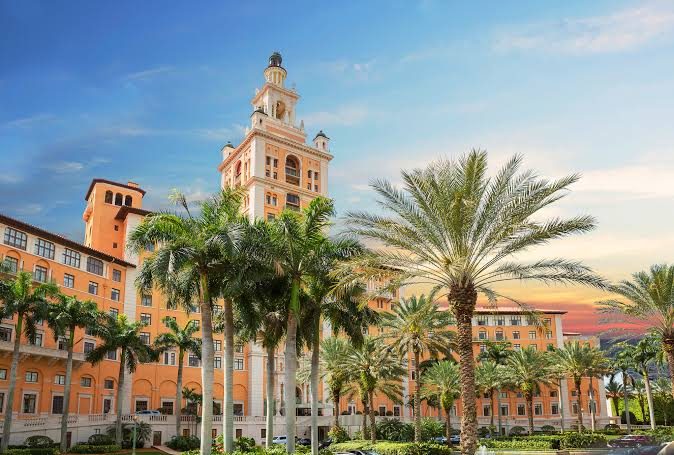
The Biltmore Hotel opened in 1926 and its bell tower is still the tallest structure most people associate with Coral Gables, even though it’s nowhere near the tallest building in Miami-Dade. That’s intentional. Merrick designed the city so the Biltmore’s tower would remain visible from key sightlines, and the city has protected that view corridor for a century, which is part of why height limits in the surrounding blocks are as tight as they are.
Day to day, the Biltmore functions less like a tourist hotel and more like a country club that happens to have rooms. Residents use the Biltmore Golf Course, an 18-hole Donald Ross design that’s open to the public with tee times bookable online, without needing a hotel reservation, and it’s common to see the same regulars teeing off early on weekday mornings before work. The hotel pool, famously one of the largest hotel pools in the continental U.S., hosted Olympic swimmers training in the 1920s and 30s and still runs swim lessons and lap swim for locals with pool memberships, which tend to be a genuine perk for families who live within a short drive and want something nicer than a standard community pool. Sunday brunch at the Biltmore is a genuine local tradition, not just a wedding venue thing, though it also does a heavy wedding and event business that residents on nearby streets have learned to plan around (valet overflow, event noise on weekend evenings, and a noticeable uptick in traffic on Anastasia Avenue during peak wedding season in the fall and spring).
For families evaluating the neighborhood immediately around the Biltmore, that area (often called the Biltmore section) carries some of the highest per-square-foot pricing in the city because of the golf course frontage and the historic Mediterranean Revival stock. A buyer comparing a golf-frontage lot here to a comparable lot in Weston or Parkland needs to understand the premium isn’t just about the golf course. It’s about the tower views, the walkability to the hotel amenities, and the fact that almost no new inventory can be added to this pocket because the lots were platted a century ago and the review board isn’t approving teardown-and-rebuild at scale. If luxury inventory in this price band is what you’re comparing, Coral Gables Luxury Homes: What $2M to $15M+ Gets You breaks down what that budget actually buys street by street.
Venetian Pool and the City Beautiful Plan
The Venetian Pool, carved out of a former coral rock quarry in 1923, is the clearest physical evidence of what Merrick was trying to build. It’s not a backyard amenity, it’s a public civic pool with waterfalls, caves, and a Mediterranean bathhouse, and it’s still open to residents and visitors today with seasonal hours and an admission fee (resident rates are lower with proof of Coral Gables residency, and it’s a genuinely popular spot for kids’ birthday parties booked months in advance).
This is where the “City Beautiful” plan matters for anyone considering living here long term. Merrick’s original 1920s design bundled together wide, canopy-covered boulevards (many lined with mature banyan and oak trees that the city aggressively protects through its tree ordinance, to the point where removing a large tree on your own property often requires a permit and a replacement plan), coral rock entrance gates at the city’s edges like the ones still standing at the Douglas Entrance and along Alhambra Circle, and a network of coordinated public spaces like the Venetian Pool, the Biltmore, and the Granada Golf Course. None of it is incidental. The city still enforces height limits, requires architectural review for exterior changes on most properties, and restricts commercial signage. That’s why streets platted a century ago still look coherent instead of like a patchwork of eras.
The tradeoff is real: renovations take longer and cost more because of the review process, and property owners can’t always do what they want with their own facades. A homeowner who wants to swap a barrel tile roof for a metal one, or repaint a Mediterranean Revival home a color outside the approved palette, needs Board of Architects sign-off before a permit gets pulled, and that review adds weeks to a project a contractor in Kendall or Pembroke Pines could start the following Monday. Most residents who’ve been here a while will tell you it’s worth it, because it’s the reason home values have held up and the reason the city doesn’t look like it’s constantly being torn down and rebuilt. Buyers coming from a market with no design review at all sometimes find this frustrating in year one and grateful for it by year five.
The Arts and Culture Scene
Coral Gables punches well above its size on arts and culture, and it’s concentrated enough that you can hit multiple things in one evening without much driving.
Actors’ Playhouse at the Miracle Theatre anchors live theater on Miracle Mile itself, running a full season of musicals and plays in a restored 1948 movie palace, and it’s often the first cultural stop for families new to the city because it’s genuinely kid-friendly programming alongside its adult season. GableStage, based at the Biltmore, focuses on more contemporary and provocative programming and has built a reputation well beyond South Florida, drawing theater regulars from as far as Fort Lauderdale for a single production. The Coral Gables Museum, housed in the old Police and Fire Station building, runs rotating exhibits on the city’s history and design, and is a genuinely useful first stop for anyone new to the area who wants context on why the city looks the way it does, particularly the Merrick-era planning documents and models it keeps on permanent display.
Books & Books on Aragon Avenue remains a cultural hub in its own right, hosting author events regularly and functioning as a de facto community living room where it’s common to run into the same regulars weekend after weekend. The University of Miami, whose main Coral Gables campus sits on the city’s southern edge, adds a steady stream of lectures, athletics (Hurricanes football and basketball pull a real local following, and game days noticeably change traffic patterns on US-1 and around the Biltmore), and gallery programming through the Lowe Art Museum, which runs free general admission for UM affiliates and modest ticket pricing for the public. Merrick Park and the surrounding streets also host periodic art walks and seasonal festivals, including holiday events on Miracle Mile that draw families from well outside the city limits and turn the Mile into a pedestrian-only stretch for the evening.
None of this is manufactured tourism programming. It’s what residents actually do on a Tuesday night or a Sunday afternoon, and it’s a meaningful part of why people who move here for the schools or the real estate end up staying for the lifestyle. Ask a longtime resident why they never left and the arts calendar comes up almost as often as the schools do.
Neighborhoods and What Daily Life Actually Costs
Coral Gables isn’t one neighborhood, it’s a collection of distinct pockets, and where you land changes your daily routine significantly.
Old Gables, the historic core closest to Miracle Mile and City Hall, offers the most walkability and the oldest architectural stock, much of it under strict historic designation, which means even small exterior changes go through additional review beyond the standard Board of Architects process. Coral Gables Country Club Section and the Biltmore area sit around the golf course and carry a premium for that proximity, with buyers often paying specifically for the view corridor toward the tower. Ponce Davis, technically straddling the Coral Gables and unincorporated Miami-Dade line, offers larger lots with a more suburban, canopy-road feel, and tends to attract families who want more yard and more distance between neighbors without giving up the Coral Gables school zoning or address prestige. Gables Estates, a private waterfront enclave with deepwater access, is a different price tier entirely, built for boat owners who want direct Biscayne Bay access without the bridge restrictions that limit vessel size in some other Miami-Dade waterfront communities. Each of these has a different relationship to HOA structure, price per square foot, and lot size, and the differences matter more than most outside buyers assume. A buyer who tours a home in Old Gables expecting the same lot size they’d get in Ponce Davis for the same budget is going to be disappointed, and the reverse is also true if walkability is the priority. The full breakdown is in Coral Gables Neighborhoods: Old Gables, Ponce Davis, Gables Estates and More.
Most single-family streets in Coral Gables don’t carry a mandatory HOA the way a gated Doral or Weston community would. Instead, the city itself functions as the enforcement body through its Board of Architects and code compliance division, which means the “association” a buyer needs to understand isn’t a private board, it’s a municipal one with actual regulatory teeth. Newer condo and townhome product near Merrick Park, by contrast, does carry standard condo association fees, and those run in line with other luxury mid-rise product in Miami-Dade, so budget for that monthly line item separately from the mortgage if you’re looking at anything built in the last five years, including the Alba, CORA, or Ponce Park projects mentioned above.
For a full sense of what it costs to get in the door at different price points, from a starter condo to a historic single-family rehab, the First-Time Buyer in Coral Gables guide lays out the realistic entry level, and the Coral Gables Real Estate Market update covers where prices actually stand across the city as of mid-2026.
Schools, Families, and the Daily Logistics of Living Here
Families move to Coral Gables largely for two things: the schools and the sense that the city will still look the same in twenty years. Coral Gables sits within Miami-Dade County Public Schools but has some of the strongest zoned and magnet options in the county, including Coral Gables Senior High and its feeder middle schools, plus a deep bench of private schools within a short drive, including options that draw families from Pinecrest and South Miami as well. The school landscape here is genuinely more layered than most outside buyers expect, with zoned assignment, magnet application windows, and private school admissions timelines all running on different calendars, and it deserves its own research rather than assumptions carried over from another market. The Coral Gables Schools guide covers zoned public options, magnet programs, and the private school landscape in detail.
Daily logistics: traffic on US-1 (South Dixie Highway) and along Bird Road can back up hard during rush hour, and the Douglas Road corridor gets congested near the Metrorail station and University of Miami during the school year, especially around 8am drop-off and 3pm dismissal when school traffic overlaps with the university’s own class schedule. Most families build their routine around avoiding those choke points rather than fighting them, timing errands for mid-morning or using the Trolley for anything within the historic core, which is part of why proximity to work and school matters more here than the raw square footage of a home. A family choosing between a slightly bigger house in Ponce Davis with a 20-minute commute to a Coral Gables zoned school and a smaller one in Old Gables with a 5-minute walk isn’t making a cosmetic tradeoff. That’s a real daily-life decision worth mapping out before signing a contract.
What Makes Coral Gables Different From the Rest of Miami-Dade
Put simply: control. Most of Miami-Dade’s growth over the last two decades has been driven by whatever a developer could get approved. Coral Gables inverted that relationship a century ago and has largely stuck with it. The city decided what it wanted to look like first, then let development happen inside those constraints. That’s why the tree canopy is intact, why Miracle Mile still reads as a cohesive commercial strip instead of a mixed bag of building eras, and why a home built in 1925 can sit next to one built in 2015 without either one looking out of place.
The cost of that control is friction. Renovation permits take longer. New construction gets concentrated into a handful of approved zones, like the corridor around Merrick Park carrying Alba, CORA, and The Avenue, rather than spreading organically the way it does in Doral or western Kendall. Prices reflect the scarcity that comes from all of this, which is why Coral Gables consistently prices above comparable inventory in nearby suburbs even when the square footage and lot size look similar on paper. If you’re weighing whether that premium is worth it relative to other Miami-Dade suburbs, the Coral Gables Complete Relocation Guide and Moving to Coral Gables: Miami-Dade’s Most Established Luxury City both walk through that comparison directly, including how the city stacks up against Pinecrest, South Miami, and Coconut Grove for the same buyer profile.
The Honest Version of Living Here
Coral Gables is not a city for someone who wants flexibility to build or renovate on their own timeline and budget. It is a city for someone who wants to buy into a finished vision and knows their neighbors are bound by the same rules. It is not the cheapest entry point into Miami-Dade real estate, and it will never compete with Doral or Kendall on new construction volume, because that’s not what the zoning allows, and it’s not what the buyers who choose this city are looking for in the first place.
What it offers instead is consistency. A walk down Miracle Mile in 2026 isn’t wildly different from a walk down Miracle Mile a decade ago, aside from which restaurants occupy which storefronts. The Biltmore’s bell tower still anchors the skyline. The Venetian Pool still runs on the same seasonal rhythm it has for a century. For buyers who value that kind of stability over the fastest possible appreciation or the newest possible finishes, Coral Gables remains one of the few places in South Florida where the city itself is doing the work of protecting your investment, not just the HOA on your specific street.
If you’re weighing Coral Gables against other Miami-Dade options, or trying to figure out which pocket of the city fits your budget and daily routine, that’s the exact kind of decision worth talking through before you start touring homes. DM me “GABLES” and I’ll send you the current inventory breakdown by neighborhood and price point.
More articles you might like
Coral Gables Luxury Homes: What $2M to $15M+ Actually Gets You in 2026
13 min readCoral Gables, Florida: The Complete Relocation Guide for 2026
13 min readFirst-Time Buyer in Coral Gables: What the Entry Level Looks Like
13 min readNew Construction in Coral Gables: What Is Being Built and What It Costs
13 min readCoral Gables Investment Property: What the Market Looks Like for Investors in 2026
14 min read