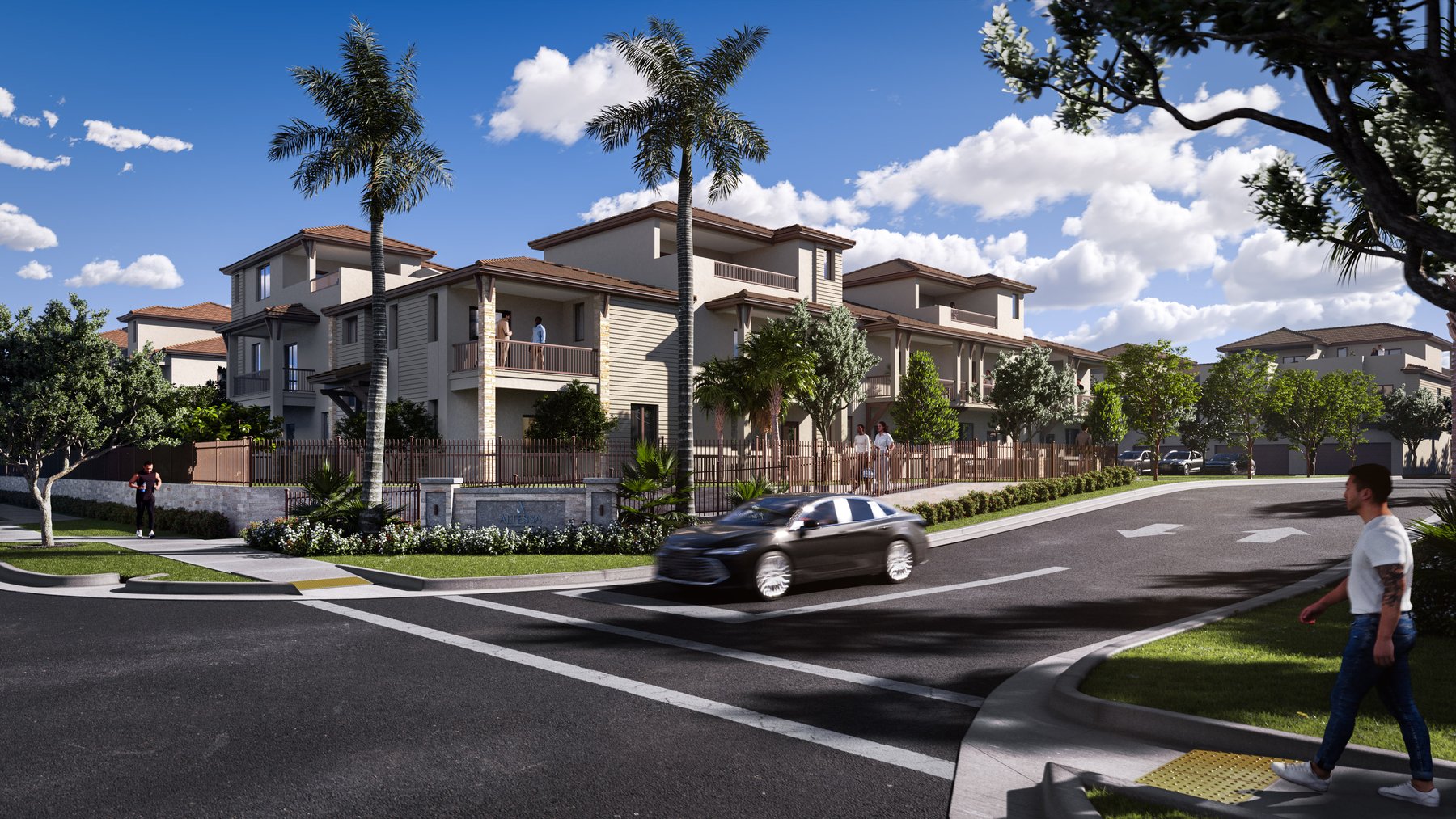
Solterra HOA & CDD Fees: What You'll Actually Pay Every Month
Here is the full revised blog post:
If you’re pricing out a home at Solterra in Sunrise, the number on the Lennar price sheet is not the number you’ll actually pay every month. Between the HOA dues and a Community Development District (CDD) assessment, Solterra buyers are looking at roughly $565 to $708 a month in fixed community costs before the mortgage payment even enters the picture. That’s the honest answer to solterra hoa cdd fees, and it’s the number almost nobody explains to you at the sales center. Below is the full breakdown: what the HOA covers, whether there’s really a CDD, how it’s billed, and how to run your own budget before you get attached to a specific floor plan.
Here’s a scenario that plays out at Solterra almost every weekend. A couple relocating from New Jersey walks the Aurora model, falls for the open kitchen and the impact glass, and gets quoted a base price and an HOA number. Nobody mentions the CDD unless they ask directly, because it’s not a line item that shows up on the model home price card, it shows up months later on a tax bill. That gap between what gets said out loud and what actually lands in your mailbox is exactly what this article is here to close.
The Real Monthly Number at Solterra (Before the Mortgage)
Here’s the math laid out plainly, because this is the part that gets glossed over in a 45 minute sales tour:
- HOA dues: $385 to $496 per month, depending on collection and phase
- CDD assessment: roughly $2,160 to $2,544 per year, which works out to about $180 to $212 per month if you spread it out
- Combined fixed cost: approximately $565 to $708 per month
That combined number is on top of your principal and interest, property taxes, and homeowners insurance. It’s not a scare tactic, it’s just math that a lot of new construction buyers don’t do until after they’ve fallen for a model home and started signing paperwork. If you’re comparing Solterra to a resale home in an older, non-CDD Sunrise neighborhood, that $565 to $708 a month is the real difference in carrying cost, and it’s worth knowing before you walk the models, not after.
Run that number out over time and it gets real fast. Over a five year hold, $565 to $708 a month in fixed community costs adds up to roughly $34,000 to $42,500, money that isn’t touching your principal balance and isn’t building equity. That’s not a reason to avoid Solterra. It’s a reason to know the number going in, the same way you’d know your interest rate before you locked it.
For the full pricing and floor plan picture that this fee structure sits on top of, start with the Solterra community profile, which lays out current availability and collection pricing.
What the HOA at Solterra Actually Covers
Solterra’s HOA dues run $385 to $496 a month. That’s a meaningful jump from the older “$188 a month” figure some sites still have floating around online, so if you saw that number somewhere, update it. It’s outdated.
What you get for that dues payment:
- Manned gate access with security staffing, not just a keypad
- Resort-style pool and pool deck area
- Clubhouse for community events and gathering space
- Fitness center on site, so you’re not driving to LA Fitness on Oakland Park Boulevard every morning
- Bike and walking paths throughout the community
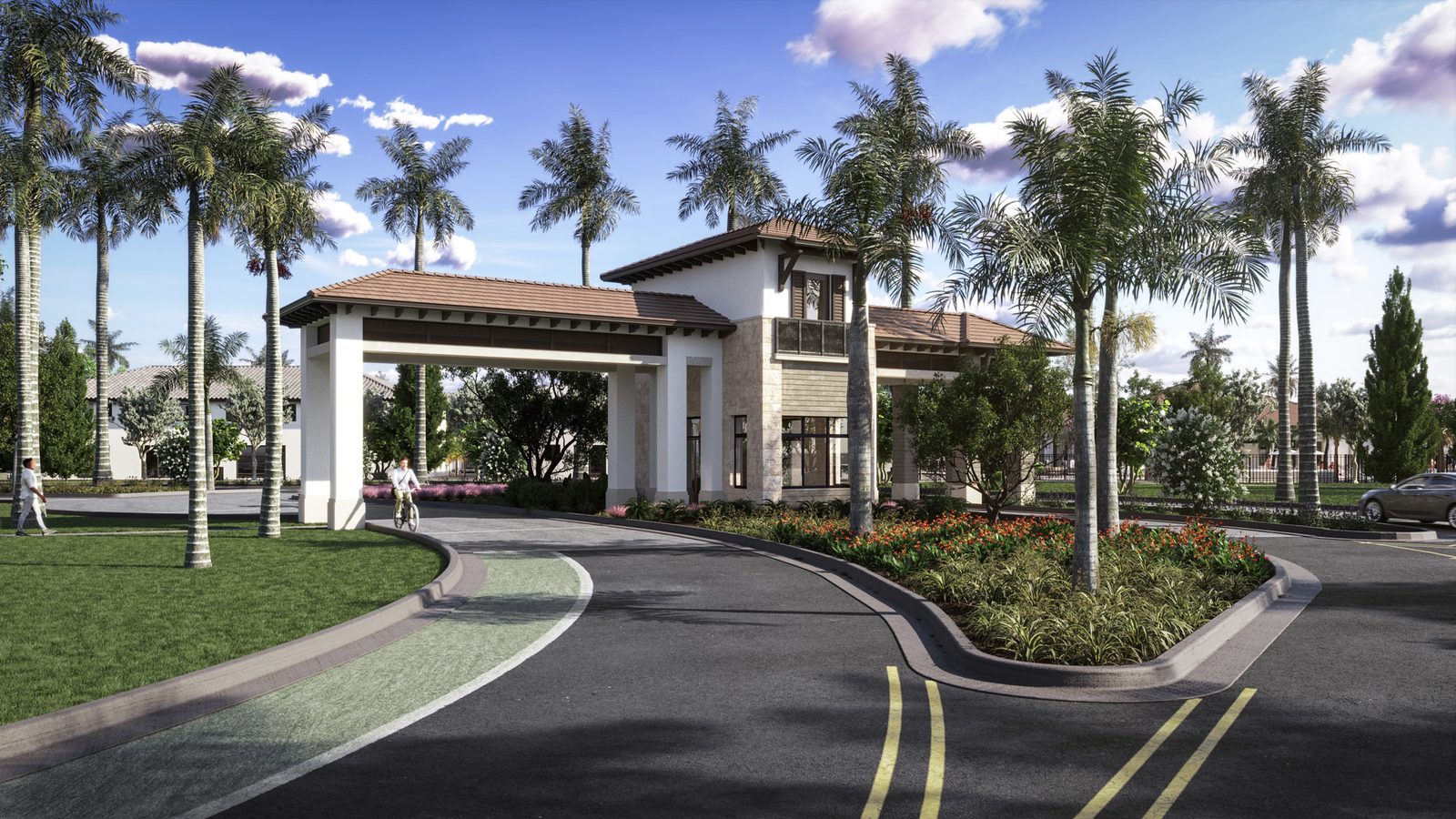
- Common area landscaping and maintenance, which matters more than people think in a gated community where curb appeal is part of what you’re paying for
This is a fairly standard new construction gated-community amenity package for the west Broward corridor. It’s comparable to what you’d see at communities like Vineyards in Davie, another Broward new construction community with its own HOA and CDD structure worth comparing side by side if you’re cross-shopping.
Think about what that $385 to $496 is actually replacing. In a lot of older Sunrise neighborhoods without an HOA, you’re paying for your own lawn service, your own gate never existed in the first place, and there’s no shared amenity center to maintain. So part of that dues payment is buying you convenience and security, not just a fee for the sake of a fee. The honest way to frame it: if you’d pay $150 to $200 a month for lawn care and a gym membership anyway, the real “extra” cost of the HOA is smaller than the sticker number suggests. It’s still worth pricing separately, but it’s not pure overhead.
The reality is HOA dues in this range aren’t unusual for a gated, amenity-rich new construction community in Broward. What trips people up isn’t the HOA number itself, it’s not knowing there’s a second bill layered on top of it.
What Is a CDD, and Why Does Solterra Have One
A Community Development District is a special local government unit that developers use to finance the infrastructure that makes a new community possible: roads, drainage, utilities, sometimes the amenity center itself. The developer takes on bond debt to build that infrastructure, and then that debt gets paid back over time by the homeowners who move in, through the CDD assessment.
Here’s what that means in plain terms: the CDD isn’t optional, it isn’t a membership you can decline, and it isn’t the same thing as the HOA even though both are showing up because you bought in a planned, amenitized community. The HOA pays for day to day operations and upkeep (landscaping, the gate, pool maintenance). The CDD is paying down the infrastructure debt that built the neighborhood in the first place.
Florida has used CDDs since the 1980s under state statute, and they’re common across new construction in Broward, Palm Beach, and especially the western corridors where developers are building out raw land into full communities. Roads that didn’t exist before, drainage systems to handle South Florida’s rainy season, water and sewer lines out to the site, sometimes the clubhouse and pool themselves. Somebody has to front that cost before a single house sells, and the CDD structure lets the developer borrow against future assessments rather than baking the entire infrastructure cost into day one pricing. In theory, that keeps the base home price lower than it would be otherwise. Whether that tradeoff actually nets out in your favor depends on how long you plan to own the home and what the bond payoff schedule looks like.
At Solterra, that CDD assessment runs approximately $2,160 to $2,544 a year. Confirmed: Solterra is inside a CDD. This isn’t a maybe. If a sales rep tells you there’s no CDD, or glosses past the question, ask them to point to the exact line on the TRIM notice or closing disclosure. It should be there.
How the CDD Bill Actually Shows Up (Read This Before You Budget)
This is the part that catches new construction buyers off guard almost every time, and it’s worth explaining clearly rather than assuming you already know.
The CDD assessment is usually collected through your annual Broward County property tax bill, the same TRIM notice and tax bill you’re already getting for ad valorem property taxes. It is not a separate invoice that arrives monthly like your HOA dues. That has two practical effects:
First, your property tax bill at a CDD community will be noticeably higher than a similarly priced home outside a CDD, and if you’re only comparing “property tax rate” between Solterra and a non-CDD resale home, you’re not comparing apples to apples. You have to add the CDD line into your tax bill estimate.
Second, because it’s billed annually rather than monthly, it’s easy to underbudget. A lot of buyers mentally track “HOA is $450 a month” and stop there, then get surprised in November when the tax bill lands with an extra $2,000 to $2,500 tacked on. If you escrow your taxes and insurance through your mortgage servicer (most buyers do), your servicer will eventually adjust your monthly escrow payment upward to account for it, sometimes with an escrow shortage bill the following year if the original estimate was too low. Either way, the CDD isn’t avoidable. It just shows up on a different bill than the HOA.
Here’s what that actually looks like in year one. A lot of new construction closings happen before the first full tax bill has been calculated on the finished home, so your lender may estimate your escrow based on the land value or a partial assessment. Then the following year, once the county reassesses the completed home and the CDD is fully reflected, your servicer sends a letter saying your escrow account came up short and your monthly payment is going up. That’s not a mistake or a scam, it’s just how the timeline works when you buy new construction. Ask your lender directly whether your initial escrow estimate includes the CDD at its full assessed rate, or whether it’s using a placeholder that will need to be corrected once the county catches up.
The move here: when you’re calculating what a Solterra home actually costs you monthly, take that $2,160 to $2,544 annual CDD figure, divide by 12, and add it to your mortgage math from day one, even though you won’t literally write that check every month. Treat it like it’s monthly, because functionally it is.
HOA vs. CDD: The Distinction That Actually Matters
People use “HOA fees” as a catchall term, and at a CDD community like Solterra that shorthand actually costs you money in your planning. Here’s the side by side:
| HOA | CDD | |
|---|---|---|
| What it pays for | Gate staffing, pool/clubhouse/fitness center upkeep, landscaping, day to day operations | Infrastructure bond debt: roads, drainage, utilities, sometimes the amenity center construction itself |
| How it’s billed | Monthly or quarterly, direct from the HOA management company | Annually, through your property tax bill |
| At Solterra | $385 to $496/month | Roughly $2,160 to $2,544/year (about $180 to $212/month spread out) |
| Can it go away | No, but the rate can change with board votes and budgets | Eventually, once the bond is paid off, though that can take 15 to 30 years depending on the bond term |
If you’re relocating from a state without CDDs (a lot of Solterra’s buyer pool is coming from the Northeast or Midwest), this structure is genuinely unfamiliar, and it’s worth having your own Realtor walk you through it rather than getting the summary version from a builder rep whose job is to get you to sign. Buyers from states like New York or Ohio sometimes assume the HOA is the whole story because that’s the only recurring community fee they’ve ever dealt with. In Florida, especially in newer western Broward developments, assuming there’s no second bill is the single most common budgeting mistake relocation buyers make.
Which Collection You Buy Changes the Number
Solterra isn’t priced or fee-structured as one flat product. The community is built across a few different collections, and the HOA/CDD burden lands differently depending on which one you’re in relative to home price:
- Villas, priced around $543K, come without a garage. On a lower base price, that $385 to $496 HOA plus CDD represents a bigger percentage of your total monthly housing cost.
- Townhomes, priced in the low $600s, come with a one car garage and sit in the middle of the fee to price ratio.
- Single-family homes, priced roughly $750K to $839K, carry the same HOA/CDD range but represent a smaller percentage bite out of a larger overall payment.
This matters most for first-time buyers and investors looking at the villa product, where the fixed monthly cost (HOA plus CDD spread monthly) can meaningfully affect debt-to-income calculations on a mortgage pre-approval. If you’re stretching to qualify, run the HOA and CDD numbers with your lender before you fall for a specific unit, not after. For a full breakdown of what each collection actually looks like inside, floor plan by floor plan, see Solterra Floor Plans Explained, which maps square footage and layout to each price point.
A Real Buyer Scenario: Running the Numbers on a Solterra Villa
Say you’re a first-time buyer putting 3.5 percent down on an FHA loan for a $543,000 villa. Your principal and interest on that loan, at a rate in the high sixes, lands somewhere around $3,400 to $3,500 a month. Add property taxes on a home that value, roughly $700 to $800 a month once the CDD is folded into the tax bill, plus homeowners insurance in the $250 to $350 range that’s typical for new construction with impact glass and CBS block. Now add the HOA at the top end, call it $496.
Stack that up and you’re looking at a total monthly payment somewhere around $4,850 to $5,150, not the $3,400 to $3,500 that the mortgage calculator on the builder’s website shows you when it only accounts for principal and interest. That’s the gap that trips up FHA buyers specifically, because FHA debt-to-income limits are stricter, and lenders are required to count the full HOA and the CDD portion of your tax escrow against your qualifying ratio. A buyer who assumes their payment is $3,500 and budgets accordingly can find out at underwriting that they don’t actually qualify at that price point, or that they qualify but with a much thinner monthly cushion than they expected. Running this full number with your lender before you fall for a specific villa saves you the disappointment of a denial after you’ve already picked out your lot.
Budgeting the Real Number Before You Tour a Model
Here’s a step by step way to do this correctly, before you’re standing in a decorated model home getting sold on quartz countertops and forgetting to ask about the tax bill:
- Get the current HOA dues in writing for the specific phase and collection you’re considering, not a community-wide average. Rates can shift between phases as the development matures.
- Ask for the CDD assessment schedule directly, not just “is there a CDD.” Ask what the current annual assessment is and whether it’s expected to change as more phases come online.
- Divide the CDD annual number by 12 and add it to the HOA dues to get your real fixed monthly community cost.
- Add that fixed cost to your estimated principal, interest, taxes, and insurance (PITI) to get your true all-in monthly payment.
- Run that total past your lender, especially if you’re using FHA or conventional financing with tight debt-to-income ratios, so there are no surprises at underwriting.
- Ask what the CDD bond payoff timeline looks like. It won’t change your near-term budget, but it’s useful context for how long you’ll be carrying that assessment if you plan to stay long term.
Walk through this with an actual example instead of treating it as an abstract checklist. Say you’re eyeing a townhome in the low $600s. You get the HOA in writing at $450 a month. You ask the sales rep for the CDD schedule and get a number of $2,400 a year, which is $200 a month spread out. That’s $650 a month in fixed community costs before you’ve touched the mortgage. Add that to an estimated PITI of roughly $4,200 on a $620,000 purchase with 10 percent down, and your real number is closer to $4,850, not the $4,200 the builder’s online calculator quoted you. That’s the number to bring to your lender, not the number on the price sheet.
This is exactly the kind of groundwork a buyer’s agent should be doing for you at no cost, since on new construction the builder pays the buyer’s agent commission. Touring Solterra with your own Realtor rather than going in solo means someone is asking these questions on your behalf before you’re at the table signing a contract.
Is Solterra Still Worth It With These Fees?
Yes, for the right buyer, and no for the wrong one, which is the honest answer rather than a sales pitch.
Solterra makes sense if you want gated, resort-style new construction in the I-595, Sawgrass Expressway, and I-75 corridor, with manned security and a full amenity package, and you’re not chasing a specific top-rated school zone as your number one priority. It’s a strong fit for west Broward commuters, sports and entertainment area buyers who want proximity to the Sawgrass Mills and Seminole Hard Rock corridor, and families who want new construction security without a Parkland-level budget. If school zone ranking is the deciding factor in your search, a community like Vineyards in Davie or a relocation into Parkland itself, covered in the Parkland relocation guide, might be the better fit even with its own fee structure to budget around.
It’s also worth putting Solterra’s fee load in context against other CDD communities across Broward and Palm Beach, because $565 to $708 a month is not unusually high for this type of product. Some newer master-planned communities further west, with larger amenity centers or more extensive infrastructure builds, carry combined HOA and CDD costs well north of $800 a month. Solterra sits in a middle range for what it delivers: manned gate, resort pool, clubhouse, and fitness center, without the golf course or lazy river price tag that pushes fees higher in some Palm Beach County developments. That doesn’t mean the number is small. It means it’s a fairly typical cost of admission for this category of new construction, not an outlier that should scare you off on its own.
Where Solterra stops making sense is if you’re buying at the very top of your budget and the HOA plus CDD pushes your real monthly number past what you can comfortably carry. New construction is exciting, and CDD communities are common enough in Broward that the fees themselves aren’t a red flag. What’s a problem is buying without doing this math first.
For the broader picture on pricing, current Lennar incentives, and how Solterra stacks up against comparable west Broward new construction, read Is Solterra Worth It? and the full Solterra by Lennar Review, both of which go deeper into the floor plans and value question beyond just the fee structure covered here.
The Bottom Line
Solterra’s HOA runs $385 to $496 a month. The CDD assessment adds roughly $2,160 to $2,544 a year, billed through your property tax bill rather than monthly. Combined, that’s about $565 to $708 a month in fixed community costs before your mortgage payment. Neither number is hidden exactly, but neither one is volunteered clearly either, and the CDD in particular gets missed because it shows up on a different bill than the HOA.
Before you register at the sales center or fall in love with a specific model, get the actual current HOA and CDD figures in writing for your collection and phase, run them through your lender alongside your mortgage estimate, and know your real number going in. If you want a second set of eyes on the math, or want someone in your corner at the sales center who isn’t working for Lennar, reach out before you sign anything. On new construction, it costs you nothing to have your own Realtor at the table.

Watch: learn more
Go deeper with my South Florida Insider videos.
Solterra: Everything You Need to Know Before You Visit
Solterra: Everything You Need to Know Before You Visit
More articles you might like
Is Solterra Worth It? An Honest Look at Lennar's Sunrise Community
13 min readSolterra Floor Plans Explained (2026): Sizes, Layouts, and Which One Fits
15 min readSolterra Sunrise New Construction: The Complete Buyer's Guide to Floor Plans, Pricing, and HOA Costs
14 min readSolterra by Lennar Review (2026): Prices, Floor Plans, HOA, CDD, and Who It's For
18 min readSolterra, Sunrise HOA & CDD Fees: What You'll Actually Pay Every Month
19 min read