Weston vs Coral Springs: Which Broward Family Suburb Wins?
If you’re cross-shopping Broward’s two biggest family suburbs, here’s the answer before you read another word: Weston wins if your budget starts around $750,000 and you want the most controlled, top-ranked-school environment in the county. Coral Springs wins if you want A-rated schools, a real neighborhood feel, and you’d rather put an extra $100,000 or more into the house itself instead of the zip code. Neither city is “better” in some universal sense. They serve different budgets and different priorities, and I’ve helped families land happily in both. Let’s break down exactly why.
Weston vs Coral Springs: Which Broward Family Suburb Wins?
I get this question constantly from relocating families, especially people coming down from the Northeast or out of California who did a Google search and landed on both names. Weston and Coral Springs sit about 15 minutes apart in western Broward County, both are known for good schools and low crime, and both get recommended in the same breath by relocation agents. But they’re not interchangeable, and picking the wrong one for your budget and priorities is an expensive mistake to unwind two years later.
The short version: Weston is the polished, master-planned suburb with the state’s top-tier school zoning and a price tag to match. Coral Springs is the value play next door to Parkland, delivering A-rated schools and established neighborhoods for meaningfully less money, and it’s in the middle of a real downtown transformation. If you want the full picture on Weston specifically before you compare it to anything else, I’d start with my complete guide to Weston, which covers the city on its own terms.
Here’s a detail that matters more than people think when they’re comparing these two on paper: they didn’t grow the same way. Weston was essentially built as one master-planned city starting in the 1990s, so the architecture, the landscaping, and the HOA structure are consistent from one section to the next. Coral Springs grew in waves starting in the 1960s, which means you’ll find 1970s ranch homes a few blocks from newer construction, and older shopping plazas next to brand-new mixed-use development. That difference in how each city came together explains almost everything else on this list, the pricing, the polish, the HOA intensity, all of it traces back to that.
Home Prices: What You Actually Pay in Each City
This is where most families make their decision, so let’s be specific instead of vague.
Weston pricing
Weston’s single-family home values typically sit in the mid-$700,000s for a standard family home. That’s the baseline, not the ceiling. Once you move into the bigger, established estate sections, particularly around the golf course communities and the larger lot subdivisions west of the Everglades buffer, you’re looking at $900,000 on the low end running past $2.5 million for the premium properties. Communities like Weston Hills Country Club, Windmill Ranch Estates, Provence, and Savanna all sit in that upper tier, and they command a real premium over the more standard family sections closer to Weston Town Center. Weston is essentially built out at this point. There isn’t a wave of new subdivisions coming to add inventory, which is part of why prices have stayed firm even when other parts of Broward softened. If you want the granular detail on what premium buyers are actually getting for that money, I broke it down in Weston Luxury Homes: What the Premium Market Looks Like in 2026. And if you’re trying to find a way into Weston without a $750,000 check, my piece on what the entry level actually looks like is worth reading before you assume you’re priced out entirely.
Coral Springs pricing
Coral Springs is the more affordable of the two, and it’s not close. Single-family median value runs around $657,000, roughly $100,000 less than Weston for a comparable home. That gap matters more than it sounds like on paper. On a typical 30-year mortgage at current rates, that difference is often $500 to $700 a month in payment, money a family can put toward private lessons, a better car, savings, or simply breathing room. Run the math over ten years and you’re talking about $60,000 to $80,000 in freed-up cash flow, before you even account for what that money could earn if it were invested instead of tied up in a higher mortgage payment. Coral Springs also has more variety in housing stock age and style since it developed over a longer stretch of decades, so you’ll find everything from older 1970s and 80s ranch-style homes that need updating to newer construction on the city’s edges. Neighborhoods like Eagle Trace and Turtle Run tend to sit on the higher end of the Coral Springs range, while sections closer to the city’s older core can come in well under the median for buyers who want to renovate rather than buy finished.
Schools: Cypress Bay’s Reputation vs Coral Springs’ A-Rated Depth
Schools are usually the real driver behind this comparison, so let’s not gloss over it.
Weston is zoned almost entirely for Cypress Bay High School, which consistently ranks as a top-20 high school in the entire state of Florida. The key detail people miss: you don’t need to win a magnet lottery or apply to a special program to get your kid into Cypress Bay. If you live in Weston, that’s your zoned school, full stop. Feeder schools like Tequesta Trace Middle, Falcon Cove Middle, Everglades Elementary, and Manatee Bay Elementary carry the same reputation for strong academics and well-funded extracurriculars, so the quality holds up long before high school. For families who want a guaranteed top-tier outcome without gambling on a lottery number, that certainty is worth real money to them, and it’s reflected in Weston’s home prices. For a deeper look at exactly why families pay that premium, read Weston Schools: The Reason Families Pay the Premium.
Coral Springs is not a downgrade, it’s a different tier of the same quality bracket. The city is served by strong, A-rated schools including J.P. Taravella High School and Coral Springs High School, both with solid academic reputations and established sports and arts programs. Feeder schools throughout the city, Ramblewood Middle, Westchester Elementary, and Riverside Elementary among them, carry consistent A ratings as well, so the strength isn’t limited to the high school level. Here’s the detail that surprises a lot of relocating families: some Coral Springs addresses are actually zoned into Marjory Stoneman Douglas High School in neighboring Parkland, one of the most academically decorated schools in the state. That means you can, in the right pocket of Coral Springs, get Parkland-caliber school zoning without paying Parkland’s home prices. That’s the exact value proposition I mean when I tell families Coral Springs is “Parkland-adjacent without the Parkland premium.” If school zoning is the deciding factor for you, don’t just trust a listing description, pull the actual Broward County Public Schools boundary map for the specific address before you write an offer. Zoning lines shift, and I’ve seen buyers assume they were in a certain district when they weren’t.
Lifestyle and Day-to-Day: Town Center vs a Downtown Still Being Built
This is where the two cities feel genuinely different, not just priced differently.
Weston’s built-out polish
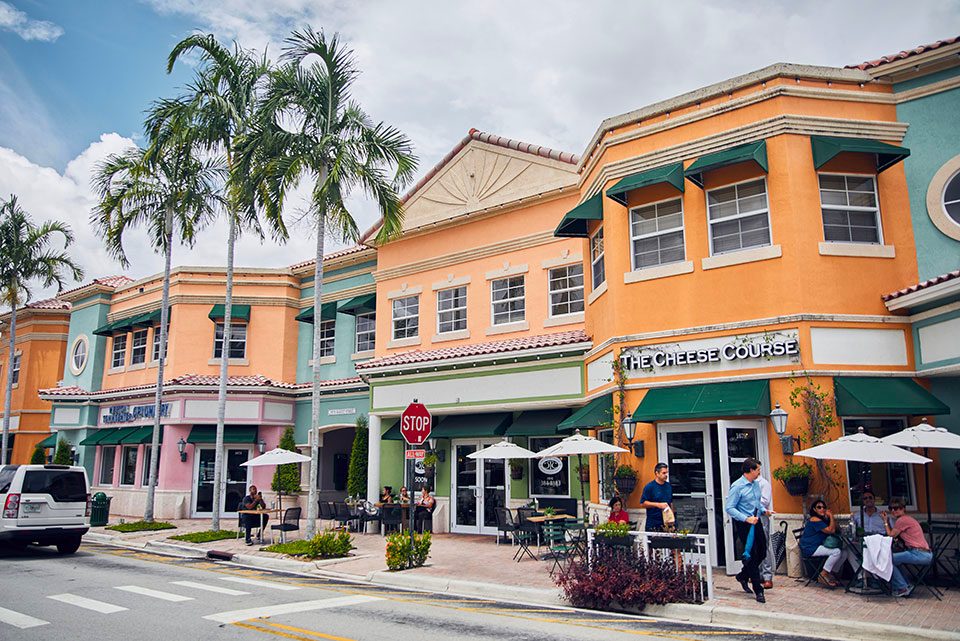
Weston Town Center is the city’s social and commercial hub, a walkable outdoor mall with restaurants, a movie theater, seasonal events, and a farmers market that draws families out on weekends. Everything in Weston feels finished. The landscaping is manicured, the signage is uniform, the roads are wide and well maintained. Families also lean on Weston Regional Park and the nearby Markham Park and Vista View Park for soccer leagues, picnic pavilions, and walking trails along the canals, which gives the city a genuine outdoor, active feel even though it’s inland. This isn’t an accident, it’s the product of decades of deliberate master planning. If you want the day-to-day texture of what living there actually feels like, from parks to dining to the general rhythm of the place, I go deep on it in Life in Weston: Town Center, Parks, Dining, and the Day-to-Day Reality.
Coral Springs mid-transformation
Coral Springs is a different story right now, and honestly a more interesting one if you’re watching where a city is headed rather than where it already is. The city is actively building a walkable downtown from scratch at Cornerstone Plaza, bringing in new dining and retail to a corridor that previously didn’t have a true center of gravity. Established amenities like the Coral Springs Aquatic Complex and Mullins Park already give families a strong base of recreation, sports leagues, and community events, so it’s not as if the city was starting from nothing. Some pockets of Coral Springs still feel dated, older strip malls, homes that haven’t been updated since the 90s. That’s the honest trade-off for the lower price. But if you’re the type of buyer who likes getting into a city on the way up rather than paying full price for a finished product, Coral Springs right now is that opportunity.
HOA Rules, CDD Fees, and How Much Control You’re Signing Up For
Nobody talks about this enough, and it genuinely affects daily life, not just your closing costs.
Weston is hyper-regulated. HOA rules govern everything from what color you can paint your front door to signage in your own yard, to how long your garage door can stay open. Depending on the section of the city, HOA dues can run anywhere from a couple hundred dollars a year in some single-family sections up to several hundred dollars a month in the gated, amenity-heavy communities like Weston Hills or Savanna. For some families, that’s exactly the point, it’s what keeps the neighborhood looking uniform and protects resale value. For others, it feels suffocating fast. If you’re the type of person who wants to park a boat trailer in your driveway or put up holiday lights the HOA doesn’t love, Weston will frustrate you.
Coral Springs still has HOAs in most of its planned communities, but the level of regulation is generally less intense than Weston’s, and there’s more variation neighborhood to neighborhood since the city wasn’t built under one master plan the way Weston was. Some of the city’s older, non-gated sections have no HOA at all, which is a real draw for buyers who want more flexibility with their own property. If you’re comparing new construction or planned communities in either city, it’s worth understanding what CDD and HOA obligations actually look like on paper before you fall in love with a floor plan. My piece on New Construction in Weston: What Is Available and Is It Worth the Premium? covers that in detail for Weston specifically, including where the fee structures get complicated.
Commute and Location: Where Each City Actually Sits
Both cities sit in western Broward, but the commute reality differs enough to matter for anyone working east toward Fort Lauderdale or south into Miami-Dade.
Weston sits closer to the Sawgrass Expressway and I-75, which is convenient if you’re headed toward Sawgrass Mills, Plantation, or points north and west. But if your job is in downtown Miami or Brickell, that daily commute will genuinely test your patience during rush hour. You’re looking at roughly 30 to 40 miles depending on the exact address, and on a bad weekday afternoon that drive down I-75 and onto the Dolphin Expressway or Palmetto can eat well over an hour each way. It’s not a short drive on a good day.
Coral Springs sits further north and slightly east, with access to the Sawgrass Expressway and University Drive, putting it in a reasonable position for commutes toward Fort Lauderdale, Boca Raton, and the broader Broward and Palm Beach job corridor. A commute from Coral Springs into downtown Fort Lauderdale off-peak can run 25 to 35 minutes via University Drive or I-95, which is a noticeably easier daily rhythm than what Weston commuters headed toward Miami deal with. Neither city is a short hop to the beach, and that’s worth setting expectations on up front. Both are inland, family-oriented suburbs, not coastal lifestyle towns, so if weekend beach access is a top priority for your family, factor that 30-plus minute drive into your decision regardless of which city you pick.
Who Should Actually Choose Weston
Weston makes sense if:
- Your budget comfortably supports $750,000 or more for a home.
- Guaranteed zoning into a top-20 statewide high school, without a lottery, is a non-negotiable priority.
- You want a heavily planned, uniform, low-drama neighborhood aesthetic and don’t mind HOA rules that enforce it.
- You’re relocating from the Northeast, California, or Latin America and want a community where you won’t feel like an outlier, Weston has deep transplant populations from all three.
- You’re not commuting daily into downtown Miami, or you’re prepared for that drive.
If any of those five don’t line up, Weston will feel like an expensive mismatch rather than a win. I’ve had clients who could technically afford Weston but chafed against the HOA rules within six months of closing, and clients who loved the structure and would never live anywhere else. Know which one you are before you sign. Before you commit, it’s also worth understanding the specific neighborhoods within Weston, since not every pocket of the city offers the same trade-offs. I cover that breakdown in Weston Neighborhoods and Communities: What to Know Before You Choose.
Who Should Actually Choose Coral Springs
Coral Springs makes more sense if:
- Your budget is closer to $600,000 to $700,000 and you want more house for that number.
- You want A-rated schools and are open to a zoning lottery that could land you in Marjory Stoneman Douglas territory, without paying Parkland prices.
- You’re comfortable with a city that’s still finishing its transformation, rather than one that’s already polished top to bottom.
- You’d rather invest the price difference into the home itself, renovations, a pool, a bigger lot, than into the surrounding infrastructure.
- You want to be close to Parkland’s job base and amenities without Parkland’s price tag.
A lot of the families who end up in Coral Springs are the ones who ran the numbers on Weston, liked what they saw, and then realized they’d rather have a pool and an updated kitchen for the same monthly payment than the extra polish of a fully built-out master plan. Neither choice is wrong. It’s a question of what you actually want to spend that extra $100,000 on.
The Verdict: Which Broward Family Suburb Actually Wins
Here’s the honest answer, and it’s not a cop-out: there isn’t a single winner, there’s a winner for your specific situation. If money isn’t the deciding factor and you want the most buttoned-up, top-tier-school suburb Broward has to offer, Weston wins. If you want strong A-rated schools, more square footage for your dollar, and you’re willing to bet on a city that’s actively investing in its own downtown right now, Coral Springs wins.
What I’d actually tell a client sitting across from me: don’t pick based on reputation alone. Drive both cities on a weekday afternoon and again on a Saturday. Sit in Weston Town Center for an hour, then go sit at Cornerstone Plaza in Coral Springs and see which one feels like where your family actually wants to spend the next ten years. Reputation gets you interested, but the day-to-day is what you’ll actually live in. Bring your kids if you can. A ten-year-old will tell you in about five minutes which place feels like home, and that instinct is usually worth more than another spreadsheet comparison. If you want current numbers before you make that call, my Weston Real Estate Market Update: Prices and Conditions in Mid-2026 has the latest on where Weston pricing stands relative to the rest of Broward.
Frequently Asked Questions
Is Weston or Coral Springs better for families? Both are legitimate, strong family suburbs. Weston wins on top-tier school zoning and overall polish, but you’re paying a real premium for it. Coral Springs wins on value, delivering solid A-rated schools and established neighborhoods at a noticeably lower price point.
How much more does it cost to live in Weston than Coral Springs? Weston’s single-family median sits around the mid-$700,000s, compared to roughly $657,000 in Coral Springs. That gap widens fast once you move into Weston’s larger estate sections, which run from $900,000 up past $2.5 million.
Which city has better schools, Weston or Coral Springs? Weston is zoned for Cypress Bay High, a top-20 school statewide with guaranteed zoning and no magnet lottery. Coral Springs also carries A-rated schools including J.P. Taravella and Coral Springs High, and some addresses are zoned into neighboring Parkland’s Marjory Stoneman Douglas High School, giving certain Coral Springs buyers Parkland-level school access without the Parkland price tag.
Which city has an easier commute to Fort Lauderdale or Miami? Coral Springs generally has the easier commute toward downtown Fort Lauderdale via University Drive or I-95, often 25 to 35 minutes off-peak. Weston sits further from I-95 and closer to I-75, so a commute into downtown Miami or Brickell can run well over an hour during rush hour. If your job is east of Fort Lauderdale, factor drive time into your decision as heavily as price and schools.
Are HOA fees higher in Weston or Coral Springs? Weston’s HOA structure is more uniform and, in the gated and amenity-rich communities, more expensive, sometimes running several hundred dollars a month. Coral Springs has more variation, including some older, non-gated neighborhoods with no HOA at all, which gives buyers more flexibility if they want to avoid tight architectural rules altogether.
More articles you might like
Weston vs Coral Springs: Which Broward County Suburb Is Better for Families?
17 min readWeston, Florida: The Complete Guide for People Considering a Move
18 min readWeston Luxury Homes: What the Premium Market Looks Like in 2026
13 min readFirst-Time Buyer in Weston: What the Entry Level Looks Like
13 min readNew Construction in Weston: What Is Available and Is It Worth the Premium?
14 min read