Weston, Florida: The Complete Guide for People Considering a Move
Weston, Florida: The Complete Guide for People Considering a Move
If you’re searching Weston, Florida, the complete guide for people considering a move because you keep hearing the name from relocation Facebook groups or your company’s Miami office, here’s the short version: Weston is a master-planned Broward County suburb built in the 1990s by the Arvida Corporation, and it exists almost entirely for one reason, to give families a safe, orderly place to live that’s zoned for Cypress Bay High School. Everything else about Weston, the strict HOA rules, the manicured landscaping, the built-out inventory, flows from that original design intent. It’s not an accident that Weston feels different from the rest of Broward. It was engineered to feel that way.
I’ve helped enough families move into and out of Weston to know it’s not for everyone. It’s also, for the right buyer, one of the smartest school-driven purchases in South Florida. I’ve had clients relocating from Westchester County who walked into Weston and said it felt like the first place in South Florida that reminded them of home, and I’ve had clients from Fort Lauderdale’s Victoria Park who toured Weston and told me flat out it felt too quiet, too regulated, not their pace. Both reactions are correct. Weston is a specific product built for a specific buyer, and the sooner you figure out which side of that line you’re on, the less time you waste touring homes that were never going to work for you. Let’s go through what you actually need to know before you commit.
Where Weston Actually Is
Weston sits in western Broward County, bordered by the Everglades to the west, which is part of why the city stops where it stops. There’s nowhere left to build. It’s roughly 20 to 25 minutes from Fort Lauderdale-Hollywood International Airport and about 30 to 40 minutes from downtown Miami and Brickell without traffic, longer during the morning and evening rush. The main corridors are I-75, Royal Palm Boulevard, Weston Road, and Bonaventure Boulevard.
For context, Weston is also about 20 minutes from Sawgrass Mills, one of the largest outlet malls in the country, and roughly 25 minutes from Fort Lauderdale’s downtown and Las Olas corridor if you want a night out without the Miami traffic. Miami International Airport runs closer to 40 minutes depending on the time of day. If you’re comparing Weston to Miami-Dade suburbs like Doral or Pinecrest, understand that Weston trades a shorter Miami commute for a longer one, in exchange for Broward’s lower cost of living and, in most cases, lower property tax assessments than comparable Miami-Dade zip codes.
The city is organized into distinct pockets: Weston Town Center at the core, Windmill Ranch and Weston Hills for the larger estate homes, Sector 5 and Tequesta Trace for mid-range single-family, Savanna and Country Isles for established family neighborhoods, Weston Pines and Bonaventure on the more affordable end, and gated communities like Isles at Weston and Estates at Windmill Ranch for buyers who want privacy on top of everything else. If you want the full neighborhood-by-neighborhood breakdown before you pick a Realtor to tour with, read Weston Neighborhoods and Communities: What to Know Before You Choose. Where you land inside Weston changes your price, your HOA fee, and sometimes even your elementary school zoning.
Weston Schools: The Reason Most Buyers Are Actually Here
Be honest with yourself about this before you look at anything else. Most people who move to Weston are not moving for the Town Center or the golf courses. They’re moving for the schools, and specifically for Cypress Bay High School, which regularly ranks in the top 20 high schools in Florida and doesn’t require a magnet application or lottery to attend. If you live in Weston, your kid is zoned for it. That’s the entire pitch, and it’s the reason families will pay $100,000 or more over a comparable home just outside the boundary line.
Behind Cypress Bay, the feeder pattern matters just as much. Everglades Elementary, Manatee Bay Elementary, Eagle Point Elementary, and Falcon Cove Middle and Tequesta Trace Middle all carry A ratings, so you’re not buying one great school, you’re buying a full K through 12 pipeline that holds up the entire way through. That matters more than most relocating families realize at first. I’ve seen buyers focus entirely on the high school and skip verifying the elementary zoning for the specific street they’re buying on, only to find out the address they liked actually feeds a different elementary a few miles away. In a city this tightly gridded, that kind of mistake is easy to make and expensive to unwind once you’ve closed.
I go deep on the actual data, boundary maps, and how families should weigh this against nearby options in Weston Schools: The Reason Families Pay the Premium, and I’d read that before you write an offer, because school zoning lines in Broward can shift block by block and your agent needs to verify the exact address, not just the neighborhood name.
Weston Home Prices in 2026: What You’re Actually Paying
Here’s where I’ll be straight with you instead of giving you a vague range. Typical single-family home values in Weston sit around the mid-$700,000s. That’s the city-wide median, but it hides a wide spread depending on which section you’re in.
The entry point. Bonaventure and Weston Pines are where first-time buyers and move-up families find the most reasonable numbers, generally in the $600,000s. These are older sections of the city, built earlier in Weston’s development, with smaller lots and more modest square footage, but they still carry the Weston zip code and, in most cases, the Cypress Bay zoning. Homes here typically run three to four bedrooms, 1,800 to 2,400 square feet, on lots that feel tighter than the newer sections further west. If you’re trying to get into Weston without stretching into estate territory, this is where to start looking, and I break down exactly what that entry-level product looks like in First-Time Buyer in Weston: What the Entry Level Looks Like.
The middle. Sector 5, Tequesta Trace, Savanna, and Country Isles run from the high $600,000s into the $900,000s depending on lot size, whether the home has been renovated, and proximity to the Town Center. This is the range most relocating families end up buying in, because it balances house size against monthly cost. A typical buyer here is a family of four coming from a higher cost-of-living market, someone relocating from New Jersey or a corporate transfer from California, who is used to paying more for less square footage and sees Weston’s mid-tier product as a relative bargain even with the HOA and insurance stacked on top.
The estate tier. Windmill Ranch and Weston Hills are where Weston earns its reputation as a luxury suburb. Homes here start around $900,000 and run past $2.5 million for the larger estate lots, some with golf course frontage on the Weston Hills Country Club course. Buyers in this range are usually trading up from elsewhere in Broward or relocating from the Northeast or California and want the acreage feel without leaving Cypress Bay’s boundary. Lot sizes in Windmill Ranch commonly run a half acre or more, which is rare inside a Broward suburb this close to the urban core. If that’s your search, Weston Luxury Homes: What the Premium Market Looks Like in 2026 covers what’s actually moving at that price point and what buyers are getting for it.
For a current read on where pricing and inventory stand right now, not a snapshot from last year, check Weston Real Estate Market Update: Prices and Conditions in Mid-2026 before you set your budget.
HOA Fees, CDD, and the Real Monthly Cost
This is the part most out-of-state buyers underestimate, and it’s the part that actually determines whether Weston fits your budget. Nearly every community in Weston has an HOA, and many of the gated sections layer a second, community-specific association fee on top of the master Weston association. Depending on the neighborhood, HOA dues can run anywhere from roughly $150 a month in some of the non-gated single-family sections to $400 or more a month in the gated estate communities that maintain private security, common landscaping, and clubhouse amenities.
Run the actual math before you fall in love with a listing. A $750,000 home in Sector 5 with a $200 monthly HOA and roughly 1.9 percent effective tax rate is carrying close to $1,190 a month in taxes alone, plus the HOA, plus insurance that could run anywhere from $300 to $600 a month depending on the roof age and your carrier. Add that to a mortgage payment and you’re often looking at a real monthly number several hundred dollars higher than what a lender’s pre-approval letter implies, because most pre-approval estimates lean conservative on insurance and can miss the HOA line entirely if it isn’t disclosed early.
Homeowners insurance is the other number that catches people off guard, especially buyers coming from states with lower premiums. Florida property insurance has climbed hard over the past several years, and a $900,000 estate home in Windmill Ranch will carry a meaningfully higher premium than a comparable home inland or further north. Roof age matters enormously here. A home with an original 1990s roof will either need a new roof before some carriers will write a policy, or it will carry a steep premium until it’s replaced, so factor that into your offer if you’re looking at an older, unrenovated Weston resale.
Property taxes in Broward run roughly 1.8 to 2.1 percent of assessed value annually, and Weston doesn’t have a CDD (Community Development District) the way some newer master-planned communities further north or west do, since Weston predates that financing structure, but you still need to budget HOA plus insurance plus taxes as a combined monthly number, not just the mortgage payment your lender quotes you. If you’re moving from a state with no HOA culture at all, this is the single biggest mental adjustment, you’re not just paying a mortgage, you’re paying into a system that maintains the look and function of the entire city.
The Honest Tradeoffs Nobody Puts in the Listing
I tell every client the same thing about Weston: it delivers exactly what it promises, and it also costs exactly what it costs, in ways that go beyond the purchase price.
It’s a bubble, and that’s intentional. Weston was designed as a self-contained, controlled environment. Signage is heavily regulated. Landscaping standards are enforced. You will not see a boat parked in a driveway or a fence that doesn’t match community guidelines. HOA violation letters over things like an unapproved paint color or an overgrown hedge are common enough that residents joke about them. Some people find this reassuring. Other people find it stifling after a year or two. Know which one you are before you buy, because unwinding a Weston purchase after eighteen months because the rules wore on you is an expensive lesson.
Inventory is thin because the city is built out. Weston has almost no vacant land left to develop. That means new construction is essentially nonexistent within city limits, and nearly every purchase is a resale, most of them built between the mid-1990s and mid-2000s. If you’re specifically looking for brand new construction, I cover what little exists and whether it’s worth chasing in New Construction in Weston: What Is Available and Is It Worth the Premium?, but set your expectations now: you’re far more likely to be renovating a 1990s or 2000s build, updating a kitchen, replacing a roof, redoing a pool deck, than buying something untouched.
The commute will test you. If your job is in downtown Miami or Brickell, plan on 45 to 60 minutes each way during peak traffic, funneled largely through I-75 and the Turnpike, and that number can stretch past an hour on a bad accident day. Weston works well for people who work from home, work locally in Broward or western Miami-Dade, or who work in Fort Lauderdale, Plantation, or Sunrise. It works less well for a daily Brickell commuter who wants their evenings back. I’ve had clients try it for a year, decide the drive wasn’t worth it, and end up trading toward Pembroke Pines or Cooper City to shave fifteen minutes off each direction.
You’re paying a premium for the zoning, not just the house. A comparable home in Coral Springs or Coconut Creek, both of which also carry A-rated schools, will generally cost you less. Weston’s premium is specifically the combination of Cypress Bay’s ranking and the tightly controlled community environment. If you’re weighing Weston against the next-best Broward alternative, I did a direct, numbers-based comparison in Weston vs Coral Springs: Which Broward Family Suburb Wins?, and the answer isn’t the same for every buyer, it depends on how much the Cypress Bay name specifically is worth to your family versus getting more house for the same budget somewhere else in Broward.
Buyer Scenarios: Does Weston Actually Fit You?
I get some version of the same three situations from almost every family considering Weston, so let me walk through them directly.
The corporate relocation with two kids under twelve. This is the classic Weston buyer. Company is transferring you to a Miami or Fort Lauderdale office, you have a relocation budget in the $700,000 to $900,000 range, and school quality is the number one filter, above walkability, above nightlife, above almost everything else. For this buyer, Weston is usually the right call, especially if the job is based in Broward or you can work hybrid. The Sector 5, Tequesta Trace, or Savanna price band is typically the sweet spot.
The Miami professional who wants a yard. You currently rent in Brickell or Coral Gables, you’re tired of high-rise living, and you want a single-family home with a pool without leaving Miami-Dade entirely. Weston is worth touring, but be honest about the commute before you sign. If you’re in an office five days a week in Brickell, I’d usually point you toward Miami-Dade options like Pinecrest or Palmetto Bay first, and only steer you to Weston if the schools genuinely outweigh the extra 20 to 30 minutes each way.
The move-up buyer already in Broward. You’re in Plantation or Sunrise, your kids are approaching middle school age, and you’re deciding whether the jump to Weston is worth it. This is where the direct comparison against Coral Springs and Coconut Creek matters most, because you may be able to get similar school quality without the full Weston premium, depending on which section of those cities you land in.
Life in Weston: What a Normal Week Actually Looks Like
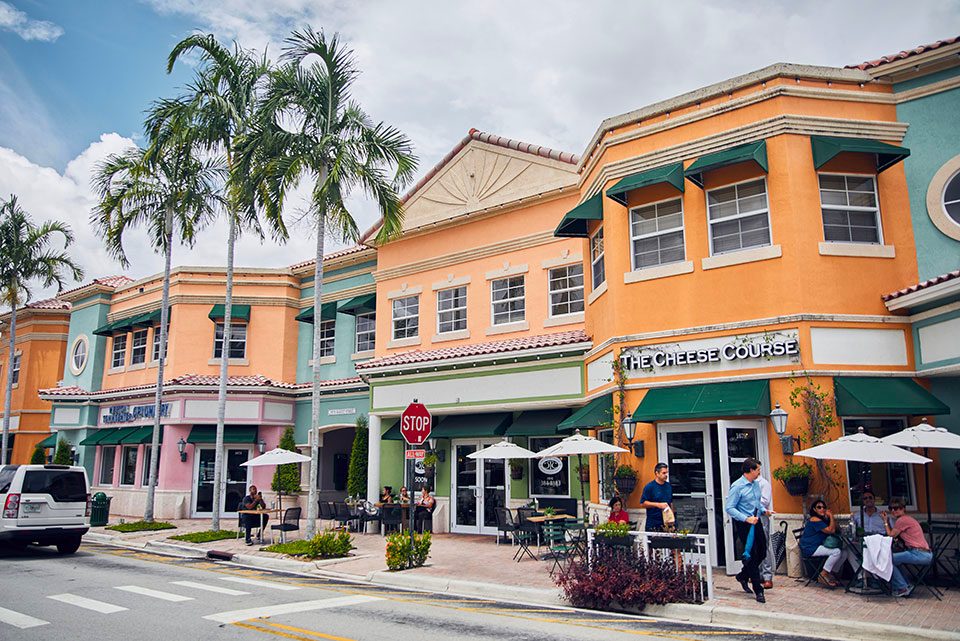
Weston Town Center is the closest thing the city has to a downtown, an open-air retail and dining district with a mix of chain restaurants, a movie theater, a farmers market, and community events built around the amphitheater. It’s pleasant and walkable within itself, but it’s not a walkable city in the way Fort Lauderdale’s Flagler Village or Wilton Manors is. You will be driving to most things, and most Weston households run two cars minimum, sometimes three once teenagers start driving.
Families lean heavily on the park system, Tequesta Trace Park, Vista Park, and Peace Mound Park among them, along with the Weston YMCA and a dense calendar of youth sports leagues, soccer, baseball, swim, and a well-regarded travel sports culture that reflects how many families here are optimizing for kids’ extracurriculars as much as academics. Weston Hills and Bonaventure both have private country club and golf options for residents who want that lifestyle built into their neighborhood. Dining skews toward reliable, family-friendly chains and a handful of well-regarded local spots rather than a dense independent restaurant scene, which is a fair tradeoff for a city that prioritizes order and safety over street-level buzz. For the full day-to-day picture, including what weekends actually look like once you move in, read Life in Weston: Town Center, Parks, Dining, and the Day-to-Day Reality.
Demographically, Weston has a strong concentration of transplants from the Northeast and Latin America, particularly Venezuela and Argentina, which has earned it the nickname Westonzuela in some circles. If you’re relocating from out of state or out of the country, you will not feel like an outlier here. That’s part of why it’s such a common landing spot for corporate relocations into South Florida, and it’s also why you’ll find a wide range of bilingual services, from pediatricians to real estate closings, without having to search for them.
Is Weston a Good Investment?
If you’re asking this as a homeowner planning to live there for the school years and then decide, the answer leans favorable, mainly because demand from school-driven buyers has been consistent for two decades and shows no sign of slowing. Cypress Bay’s reputation isn’t a recent trend, it’s been the draw since Weston was built out in the late 1990s and early 2000s, and that kind of multi-decade demand pattern is exactly what supports resale value even in a softer overall market.
If you’re asking as a pure investor looking at Weston for rental yield or flip potential, the math is tighter. Prices are high relative to rents, HOA restrictions limit what you can do with a property (some communities restrict short-term and even certain long-term rental terms, and a handful require a minimum lease term of a year or more), and the built-out nature of the city means you’re competing on renovation and presentation, not on being the newest product on the block. Flips in Weston tend to work best on older, cosmetically dated homes in strong sections like Country Isles or Savanna, where a kitchen and bathroom refresh can meaningfully move the sale price, but the margin only works if you buy right, and inventory is thin enough that buying right takes patience. I lay out the actual numbers, cap rates, and rental restrictions by community in Investing in Weston Real Estate: Is It Worth It in 2026? if that’s the angle you’re evaluating from.
Who Weston Is Actually Right For
After enough of these conversations, the pattern is consistent. Weston is right for you if:
- You have school-age kids and Cypress Bay’s ranking is worth a real premium to you.
- You value order, consistency, and enforced community standards over character or quirk.
- Your commute is to Broward, western Miami-Dade, or you work remotely, not a daily Brickell grind.
- You’re comfortable buying a resale and possibly renovating rather than chasing new construction.
- You want to be around other transplants and relocating families, not multi-generational Broward natives.
Weston is probably not right for you if you want walkable urban living, if you need new construction specifically, if a daily Miami commute is non-negotiable, or if strict HOA oversight feels more like a cage than a comfort. There’s no shame in either answer. I’d rather tell you honestly in month one that Weston isn’t your city than have you close on a home and figure that out in year two.
Next Step
If Weston keeps coming up in your search and you want help narrowing it down to the right section, the right price range, and the right timing, reach out before you start touring. It costs you nothing, and on most resale transactions the seller covers your agent’s commission, so going in without representation just means leaving free guidance on the table. Everything above, the real prices, the HOA numbers, the school data, it’s all broken down further across SouthFLInsider.com. Drop your situation, family size, budget, and where you work, and I’ll tell you straight whether Weston is the right call or whether one of Broward’s other strong-school suburbs makes more sense for what you actually need. Make a wise decision.

More articles you might like
Moving to Weston: Broward's Most Polished Suburb and What It Costs
19 min readWeston vs Coral Springs: Which Broward Family Suburb Wins?
16 min readWeston Luxury Homes: What the Premium Market Looks Like in 2026
13 min readFirst-Time Buyer in Weston: What the Entry Level Looks Like
13 min readNew Construction in Weston: What Is Available and Is It Worth the Premium?
14 min read