Hollywood, Florida: The Complete Relocation Guide for 2026
Hollywood, Florida: The Complete Relocation Guide for 2026
If you are trying to decide whether to move to Hollywood, Florida in 2026, here is the answer up front: Hollywood is the best value coastal city left in Broward County, but it is not a blank slate. It is a built-out, historic city made up of a dozen distinct neighborhoods that each behave like their own small town, and picking the wrong one is the single biggest mistake relocators make here. This guide covers where Hollywood sits geographically, what things actually cost, which neighborhoods fit which kind of buyer, what the schools look like, and the honest tradeoffs nobody puts in the brochure.
I work new construction and relocation buyers across Broward every week, and Hollywood comes up constantly from people who got priced out of Fort Lauderdale’s east side or who want beach access without paying Miami Beach money. That instinct is correct. But Hollywood rewards buyers who do their homework and punishes the ones who just look at a Zillow map and pick a pin. I have watched buyers fall in love with a listing photo of the Broadwalk, skip the flood zone conversation, and get blindsided by a five figure insurance quote at closing. This guide exists so that does not happen to you.
Where Hollywood Actually Sits
Hollywood is a coastal Broward County city sandwiched almost exactly between Fort Lauderdale and Miami. Downtown Fort Lauderdale is about 15 minutes north on I-95 or US-1. Downtown Miami is about 20 to 25 minutes south. That location is Hollywood’s entire value proposition: you get a real beach town with a walkable oceanfront boardwalk, at a price that is meaningfully lower than either of the bigger cities on either side of it.
Fort Lauderdale-Hollywood International Airport (FLL) is not just near Hollywood, it is physically inside Hollywood’s city limits along its northern edge. That is a real plus for anyone who travels often, but it also means certain neighborhoods (particularly those closest to the airport, like parts of Hollywood Hills North and the area around Sheridan Street) deal with flight noise. Ask about flight paths before you commit to a specific block, not just a specific zip code.
The city is bisected by US-1 (Federal Highway), with the western half feeling more suburban and inland, and the eastern half running toward the Intracoastal Waterway and the barrier island where Hollywood Beach and the Broadwalk sit. I-95 runs through the western edge of the city, giving quick access north to Fort Lauderdale and south to Aventura and Miami. Hollywood also borders Dania Beach to the north and Hallandale Beach to the south, and the city limits get confusing fast on the barrier island, where Hollywood Beach, North Beach Village, and Hallandale’s oceanfront towers blend together with no visible seam. If you are house hunting by address, confirm the actual municipality, not just the neighborhood name a listing agent used, because it affects your tax rate, your school zone, and your building department.
Getting Around: Roads, Airport, and the Real Commute
Most Hollywood residents drive. There is no getting around that. US-1 and I-95 are the two main north-south spines, and Hollywood Boulevard, Sheridan Street, and Pembroke Road are the primary east-west arteries connecting the beach side to the inland neighborhoods and out to the Turnpike. Traffic on Hollywood Boulevard through downtown can be genuinely slow during snowbird season (January through April) and during Broadwalk events, so factor that into your daily commute estimate if you work in Fort Lauderdale or Aventura and plan to live near the beach.
For actual commute math: Hollywood Lakes to downtown Fort Lauderdale runs about 15 to 20 minutes without traffic, closer to 30 during rush hour. Hollywood to Aventura Mall is a similar 15 to 20 minutes down US-1 or the Turnpike. Hollywood to downtown Miami is realistically 30 to 40 minutes depending on the hour, not the 20 to 25 minutes you will see on a map when traffic is light. If your job is in Brickell or Miami’s Design District, budget for that real number, not the optimistic one.
Public transit exists (Broward County Transit buses and the Sun Trolley loop downtown and along the beach), but it is not built for a car free lifestyle the way parts of downtown Fort Lauderdale or Miami’s Brickell are. Tri-Rail has a stop at the Sheridan Street station on the western edge of the city, useful if you commute toward West Palm Beach or Miami by train, but most Hollywood residents will own at least one car regardless of which neighborhood they pick.
Hollywood, Florida Neighborhoods: Picking the Right One
This is where most relocation decisions in Hollywood succeed or fail. For a full breakdown, see Hollywood, Florida Neighborhoods: Where to Live Based on What You Want, but here is the short version.
Hollywood Lakes. The most prestigious inland-adjacent neighborhood, just west of the Intracoastal. Wide lots, mature banyan trees, older Mediterranean and mid-century homes, many updated or fully rebuilt. Prices for renovated homes commonly run from the high 700s into the 1.5 million dollar range, with waterfront lots pushing higher. No HOA on most streets, which is typical for Hollywood’s older neighborhoods, but that also means no architectural review board keeping the block consistent. This neighborhood fits a buyer who wants Las Olas style curb appeal at 20 to 30 percent less than what Las Olas actually costs, and who is willing to walk or bike to the beach and to Harrison Street instead of driving.
Hollywood Hills. A larger, more affordable inland neighborhood north and west of downtown, popular with families who want more square footage for less money. Single-family homes generally range from the high 400s to the 700s depending on size and renovation level. Zoned for Hollywood Hills Elementary and closer to McArthur High. This is the neighborhood I steer growing families toward when they want a yard, a garage, and room to add a pool, without paying Hollywood Lakes prices.
Emerald Hills. A golf course community built around the Emerald Hills Golf & Country Club, quieter and more suburban in feel than the coastal neighborhoods. Homes here range widely, roughly 450 thousand to 900 thousand depending on lot size and whether it backs the golf course. Emerald Hills is the closest thing Hollywood has to a Davie or Plantation feel, cul-de-sacs, mature trees, and a slower pace, while still being a 15 minute drive to the beach.
Downtown Hollywood (Young Circle area). The walkable arts and dining core, anchored by Young Circle Park and Harrison Street. This is where you find newer townhomes, mid-rise condos, and loft-style units, generally 350 to 650 thousand dollars, with HOA dues in the 300 to 600 dollar a month range for buildings with amenities. This is the neighborhood for buyers who want a lifestyle closer to Fort Lauderdale’s FAT Village or Wilton Manors, walkable, social, and dense. It also has the best walk score in the city by a wide margin, if walkability is actually a dealbreaker for you rather than a nice to have.
Hollywood Beach and the Broadwalk. The barrier island itself. Condos dominate here, from older 1970s buildings in the 250 to 450 thousand dollar range to newer oceanfront towers well past a million. Single-family homes on the barrier island, particularly on the canals just off the beach, are some of the most expensive real estate in the city. I go deep on what daily life is actually like here in Life on the Hollywood Broadwalk: What It Is Actually Like to Live Here, including the noise, the parking, and the tourist season tradeoffs.
Boulevard Heights, Driftwood, and Liberia. The most affordable inland pockets, generally west of I-95, where you can still find single-family homes in the 400 to 500 thousand range. These neighborhoods are improving but are genuinely a different market than the coastal side of the city. Good for buyers prioritizing price over walkability or beach proximity, and for buyers who want to be close to the Hollywood Sports Park and the western commercial corridor along Pines Boulevard and University Drive.
Beverly Hills and West Lake. Smaller, less discussed pockets between the downtown core and the western neighborhoods, generally overlooked by out of town buyers because they do not show up on the same lists as Hollywood Lakes or Emerald Hills. Homes here run in the 400 to 600 thousand range, older 1960s and 1970s block construction, and they are worth a look for a buyer who wants a short drive to downtown Hollywood without the price tag of the coastal-adjacent streets.
What Homes Actually Cost in Hollywood in 2026
Numbers move, so always verify current listings, but as a working framework for 2026:
- Inland starter single-family homes (Driftwood, Boulevard Heights, parts of Liberia): roughly 425 to 550 thousand dollars.
- Mid-tier single-family (Hollywood Hills, Emerald Hills): roughly 500 to 800 thousand dollars.
- Downtown Hollywood townhomes and condos: roughly 350 to 650 thousand dollars.
- Hollywood Lakes renovated homes: roughly 750 thousand to 1.5 million dollars.
- Waterfront canal homes with ocean access: 1.2 million and up, often well up.
- Hollywood Beach condos: 250 thousand for a dated one-bedroom to well over a million for new construction oceanfront.
To put that in real terms: a family selling a 3 bedroom, 2 bath home in Plantation or Miramar for 550 thousand dollars can typically buy a comparable or larger home in Hollywood Hills or Emerald Hills for the same price, and gain 10 to 15 minutes of commute time to the beach in the process. A buyer coming from Fort Lauderdale’s Rio Vista or Colee Hammock, priced out at 1.8 million for a renovated waterfront home, can often find a comparable canal property in Hollywood Lakes for 1.1 to 1.3 million. That gap is real, and it is the single biggest reason relocators end up in Hollywood after starting their search further north.
For the full current-market read with real comparables, see Hollywood, Florida Real Estate Market: Where Prices Stand in 2026. The honest takeaway: Hollywood is no longer the cheap secret it was a decade ago, but it is still 15 to 25 percent below equivalent product in Fort Lauderdale’s coastal neighborhoods, and significantly below anything comparable in Miami-Dade.
HOA, CDD, and Insurance Reality
Most of Hollywood’s older single-family neighborhoods (Hollywood Lakes, Hollywood Hills, Emerald Hills, Boulevard Heights) have no HOA at all, because they were built decades before HOA-governed communities became standard. That is a plus for buyers who don’t want monthly fees or rule enforcement, and a minus if you want a consistently maintained streetscape. It also means you should drive the specific block you are considering, not just the neighborhood, before making an offer. One street in Hollywood Hills can look immaculate while the next one over has three homes with visible deferred maintenance, because nobody is enforcing anything.
CDDs (Community Development Districts) are essentially nonexistent in Hollywood. CDDs are a western Broward and Palm Beach County phenomenon tied to new master-planned communities on former agricultural land. Hollywood is built out and historic, so you will not find CDD fees here the way you would in Parkland or Westlake.
What you will find is real flood insurance cost. Hollywood is a coastal city with canals running through much of it, and a meaningful share of the housing stock sits in FEMA flood zones AE or VE, particularly east of US-1 and anywhere near the Intracoastal. On a canal front home in Hollywood Lakes or on the barrier island, it is not unusual to see combined flood and windstorm premiums run 4,000 to 8,000 dollars a year, sometimes more on older homes with outdated electrical panels or roofs past 15 years old. Budget flood insurance separately from homeowners insurance, get an elevation certificate before you make an offer on anything near water (expect to pay 500 to 800 dollars for one, and it is worth every cent), and factor windstorm coverage into your true monthly cost. Citizens Property Insurance is still the backstop for a lot of older coastal Broward homes, and that comes with its own rate volatility. This is the single most underestimated expense buyers hit when they move from inland areas to coastal Broward.
Schools in Hollywood
Hollywood is zoned through Broward County Public Schools, and school quality varies meaningfully by neighborhood, which is another reason the neighborhood decision matters so much here. Hollywood Hills Elementary, Orange Brook Elementary, and Hollywood Central Elementary serve different sections of the city with different ratings, and the difference between a B rated and an A rated elementary school can sit two streets apart. On the secondary side, most of Hollywood feeds into McArthur High School or South Broward High School, and Attucks Middle or Olsen Middle depending on address.
Families focused on top-rated public schools often look slightly west toward Davie and the Nova schools corridor, or lean on Hollywood’s charter and private options, including several well-regarded Catholic and independent schools in the area, such as Chaminade-Madonna College Prep and St. Bernadette Catholic School. Charter options like Somerset Academy also draw families who want an alternative to the zoned public school without a full private school tuition. I break down the full zoning map, ratings, and which streets feed which schools in Hollywood, Florida Schools: What Parents Need to Know. Do not assume a Hollywood address means a specific school. Verify the exact zoned school for the specific address before you write an offer, not after, because Broward County’s zoning lines can split a single subdivision between two different elementary schools.
The Broadwalk and the Lifestyle Case for Hollywood
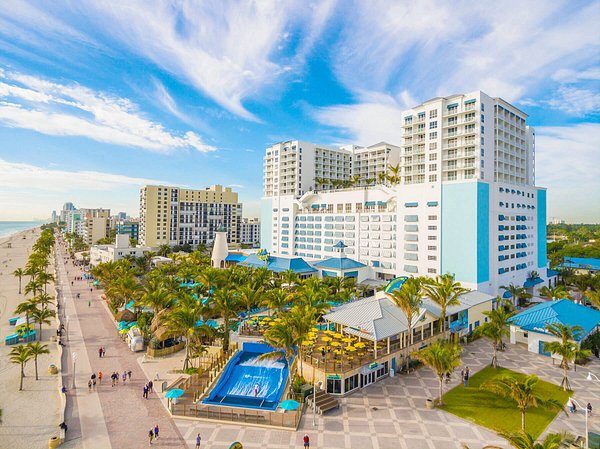
The Hollywood Broadwalk is the city’s signature asset: a 2.5 mile, car-free promenade running along the beach from north Hollywood Beach down past the Margaritaville Hollywood Beach Resort. It is genuinely one of the best pedestrian beachfront experiences in South Florida, lined with sidewalk cafes, bike and rollerblade rentals, and a mix of longtime locals and tourists. The weekly Hollywood Beach Farmers Market, the Sunday morning bike crowd, and the string of family owned restaurants along the Broadwalk give it a lived-in, unpolished character that Fort Lauderdale Beach and Miami Beach have largely lost to high-rise development.
Living near the Broadwalk means daily beach access without the density and price of Fort Lauderdale Beach or the scale of Miami Beach. It also means real seasonal tourist traffic from December through April, weekend parking headaches, and noise that increases the closer you are to the beachfront blocks. This is not a dealbreaker, but it is a lived reality, and it is exactly why I wrote a dedicated piece on it: Life on the Hollywood Broadwalk: What It Is Actually Like to Live Here.
Waterfront and Canal Living
Hollywood has an extensive canal system feeding into the Intracoastal, particularly in the Hollywood Lakes, Liberty Gardens, and Hollywood Beach areas, with many homes offering direct or short-hop ocean access for boats. This is one of Hollywood’s most underrated advantages over Fort Lauderdale: comparable canal-front product for meaningfully less money, because Hollywood has not been marketed as aggressively as the “Venice of America” canals further north.
Bridge clearances matter more than most first-time waterfront buyers realize. Several fixed bridges crossing the Intracoastal and feeding canals in the Hollywood area run in the 15 to 22 foot range at mean high tide, which is fine for most center console and sport fishing boats but will stop a sailboat with a tall mast or a larger flybridge yacht cold. If a boat is part of your relocation plan, confirm the exact bridge clearances and canal depth for the specific home, not the general area, before you assume you have ocean access. A canal home in Hollywood Lakes with true no-fixed-bridge ocean access commonly commands a 15 to 20 percent premium over an otherwise identical home on a canal with a low fixed bridge.
If a boat dock and ocean access matter to your relocation decision, this is worth serious attention, and I cover dock permitting, bridge clearances, and real canal-home pricing in Waterfront Living in Hollywood, Florida: Canal Homes and Intracoastal Access.
New Construction in Hollywood
Because Hollywood is a built-out, historic city, there is no large-scale master-planned new construction the way you’d find in Parkland, Wellington, or western Miami-Dade. What you do find is infill development: new townhome projects near downtown, boutique condo buildings on and near the beach, and scattered single-family teardown-rebuilds in Hollywood Lakes and Hollywood Hills where buyers are demolishing 1950s homes and building modern ones on the same lot.
If new construction matters to you, understand that “new” in Hollywood usually means a smaller-scale project or a custom rebuild, not a production builder community with a sales center and model row. That has real cost implications: a custom rebuild on a Hollywood Lakes lot typically runs 350 to 500 dollars per square foot once you include the lot, demolition, permitting, and construction, which puts a 2,800 square foot custom rebuild in the 1 to 1.4 million dollar range before finishes. Boutique condo buildings near the beach, where they do come to market, tend to price at a premium to comparable resale inventory because there are so few of them. I cover what’s actually being built and what it costs in New Construction in Hollywood, Florida: What Is Being Built and What It Costs.
Hollywood Compared to Its Neighbors
It helps to see Hollywood next to the cities on either side of it. Dania Beach, immediately north, is smaller, has less inventory, and is in the earlier stages of the same walkable-downtown transformation Hollywood went through a decade ago, meaning prices there are currently lower but the amenities are thinner. Hallandale Beach, immediately south, has a denser high-rise condo market along the beach with a more transient, investor-heavy feel, and it butts right up against Aventura’s retail and dining without Hollywood’s small-town downtown core. Hollywood sits in the middle of both, with more established infrastructure than Dania Beach and a more residential, less transient character than Hallandale Beach. If you toured all three and felt like something was missing, it was probably one of those two tradeoffs.
The Honest Tradeoffs
Every South Florida city has a sales pitch and a reality. Here is Hollywood’s:
What you gain versus Fort Lauderdale: lower prices for comparable square footage, a genuinely walkable beach promenade, less pretension, and a more architecturally consistent, historic housing stock in neighborhoods like Hollywood Lakes.
What you gain versus Miami: dramatically lower prices, less traffic, no comparable high-rise density, and a slower pace of life while still being 25 to 40 minutes from downtown Miami and Aventura depending on the hour.
What you give up: a meaningfully older housing stock that often needs updated electrical, plumbing, or roofing, more flood zone exposure and higher insurance costs than inland Broward, heavier seasonal tourist traffic near the beach, and airport noise in specific pockets near FLL. Hollywood also does not have the concentration of new luxury retail and dining that Fort Lauderdale’s Las Olas corridor or Miami’s Design District offer, though downtown Hollywood’s Harrison Street corridor has grown quickly and now has a legitimate restaurant and gallery scene of its own.
None of these are reasons to avoid Hollywood. They are reasons to get specific about which neighborhood, which flood zone, and which age of home you are buying into, rather than treating “Hollywood” as one uniform market.
Who Hollywood Actually Fits
Hollywood works well for buyers who want a real neighborhood feel over a manufactured one, who value beach walkability over big-box amenities, and who are comfortable doing more due diligence on an older home in exchange for a better price and more character. It fits first-time buyers priced out of Fort Lauderdale’s coastal zip codes (I cover that specific path in First-Time Buyer in Hollywood, Florida: Coastal Broward at an Accessible Price), retirees who want walkable beach living without Miami Beach prices, and investors targeting seasonal rental demand near the Broadwalk (more on returns in Hollywood, Florida Investment Property: Rental Market and Returns in 2026).
Picture three actual buyer types I see on repeat. The young couple relocating from up north who wants walkability and nightlife without Fort Lauderdale Beach prices belongs in downtown Hollywood or North Beach Village. The growing family who needs a yard, good school access, and room to add a pool belongs in Hollywood Hills or Emerald Hills, not on the barrier island. The retiree or empty nester who wants a slower pace, a boat slip, and daily beach walks belongs in Hollywood Lakes or on a quiet canal street south of the Broadwalk’s busiest blocks. If you can see yourself in one of those three, you already know which section of the city to start touring.
It fits less well for buyers who want brand-new construction with a builder warranty, buyers who need a top 10 percent rated school zone without exception, or buyers who cannot stomach flood insurance premiums on coastal property.
Next Step
If you’re serious about moving to Hollywood in 2026, start with the neighborhood decision before the home search. Get pre-qualified, get clear on your flood zone tolerance and budget, and then narrow to two or three neighborhoods that actually match your life, not just your Instagram feed. DM me “HOLLYWOOD” and I’ll send you a breakdown of current listings by neighborhood, current flood insurance ranges for the areas you’re considering, and the honest pros and cons based on what you’re actually trying to solve for.
More articles you might like
Moving to Hollywood, Florida: The Underrated Coastal City Between Fort Lauderdale and Miami
21 min readNew Construction in Hollywood, Florida: What Is Being Built and What It Costs
13 min readHollywood, Florida Schools: What Parents Need to Know in 2026
14 min readFirst-Time Buyer in Hollywood, Florida: Coastal Broward at an Accessible Price
20 min readHollywood, Florida Investment Property: Rental Market and Returns in 2026
13 min read