Life in Aventura: Mall, Marina, Waterways, and What Daily Life Really Looks Like
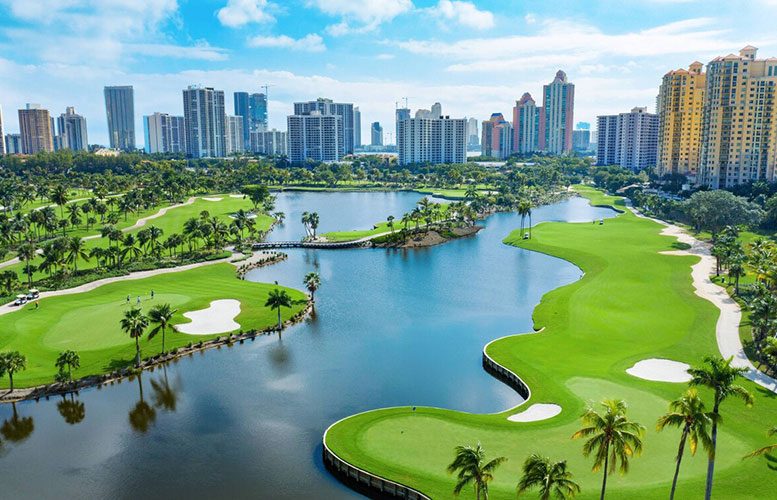
Life in Aventura mall marina waterways comes down to this: it is a small, dense, mostly-vertical city built around a shopping mall the size of a small town, wrapped by canals and Intracoastal waterway on two sides, where you can walk to dinner, valet your car more often than you park it yourself, and still be twenty five minutes from the beach in Sunny Isles or downtown Fort Lauderdale. It is not a sleepy suburb. It is not a resort town either. It is something more specific: a condo city that runs on convenience, and once you understand that, everything else about daily life here makes sense.
This guide is the deeper version of what we cover in the Aventura, Florida: The Complete Guide for 2026. That piece is your overview of the market and the city. This one is about what a Tuesday actually feels like once you live here.
What Daily Life in Aventura Mall Marina Waterways Actually Looks Like
Aventura is roughly 3.5 square miles, incorporated in 1995, sitting in northeast Miami-Dade County between Sunny Isles Beach to the east, Ojus and unincorporated Miami-Dade to the west and north, and the Broward County line just north of William Lehman Causeway. Most of the city is zip code 33180, with a sliver of 33160 shared with Sunny Isles.
There is no historic downtown here in the way you’d find in Fort Lauderdale or Delray Beach. Aventura Mall functions as the de facto town center. It is where people meet for lunch, where teenagers hang out after school, where the movie theater is, and increasingly where new residential towers are being built directly into the retail fabric. If you live in Aventura, you will end up at the mall more often than you expect, not because you’re shopping, but because it’s simply the closest place with a restaurant, a coffee shop, or a place to walk indoors when it’s ninety four degrees outside in August.
Outside the mall corridor, the city splits into two very different daily experiences: the high-rise Intracoastal side east of Biscayne Boulevard, and the lower-density Waterways side to the northwest. Both are technically “Aventura.” They do not feel the same day to day.
The Mall Isn’t Just a Mall, It’s the Town Center
Aventura Mall is the third largest mall in the United States by leasable area, anchored by Nordstrom, Bloomingdale’s, Macy’s, and a growing luxury wing with Louis Vuitton, Cartier, and other flagship stores that rival what you’d find on Miami’s Design District or Bal Harbour Shops. There’s a 24-screen Cinemark, a rock climbing wall, valet at every entrance, and a slow, ongoing buildout of residential towers connected almost directly to the retail.
For residents, the mall solves a lot of practical problems. Need a last-minute gift, a decent sit-down dinner, a coffee meeting, a place to walk laps in air conditioning during hurricane season humidity. It’s all there. Families with young kids use it as an indoor playground substitute. Retirees walk the corridors before the stores open. It is, for better or worse, the connective tissue of the city.
The tradeoff is traffic. Biscayne Boulevard (US-1) and NE 34th Avenue around the mall back up hard on weekend afternoons and during the holiday shopping season, which for a city this size means your five-minute drive can become twenty. Longtime residents learn the back routes around Aventura Boulevard and time their errands accordingly. If you’re considering a unit close to the mall for the convenience, factor that congestion into your daily routine, not just your Google Maps estimate.
Waterways: Canals, Boats, and the Other Side of Aventura
Cross north of Ives Dairy Road toward the Broward line and Aventura changes character. This is the Waterways neighborhood, built primarily through the 1980s and 1990s: townhomes, garden-style condos, and low-rise buildings backing directly onto a network of canals that connect to Maule Lake and out to the Intracoastal. Density drops, HOA architecture gets more suburban, and you start seeing single-family adjacent product instead of soaring towers.
Waterways is where boat owners in Aventura actually live. Many units here come with a private dock or deeded dockage, and it’s common to see a 25 to 35 foot boat tied up behind a townhome that looks, from the street, like an ordinary two-story unit. It’s a meaningfully different lifestyle than the high-rise side of the city: quieter streets, more green space, shopping plazas built for daily errands rather than luxury retail, and a community feel that’s closer to a Broward canal-front suburb than to Miami’s condo corridor.
If waterfront access, not skyline views, is your priority, this is the part of Aventura to focus on, and we go deeper on it in Waterfront Living in Aventura: Intracoastal Views and Marina Access.
The Marina and Boating Life (Without the Fisher Island Price Tag)
Aventura doesn’t have a single glamorous marina district the way Fort Lauderdale or Sunny Isles do, but it has real, functional boating access that doesn’t require a Fisher Island budget. Boats move out of the Waterways canals through Maule Lake, under the causeways, and into the Intracoastal, giving direct access north toward Hallandale Beach and Fort Lauderdale, or south past Sunny Isles toward Bakers Haulover Inlet and the open Atlantic.
Several of the Intracoastal-front condo towers, particularly along NE 34th Avenue and the buildings closer to Williams Island, offer marina slips or dockage as a building amenity, which means you can own a unit and rent or lease a slip without owning a canal-front property outright. Williams Island itself, a private gated island community connected by bridge, has its own marina and has historically been one of the more exclusive addresses in the city, with condo values and HOA fees to match.
For most residents, though, boating in Aventura is a rental or a friend’s-boat experience, not an ownership one. Bayside and Haulover marinas just south in Miami are common launch points for day charters, and a lot of Aventura’s water-adjacent lifestyle is really about watching the Intracoastal from a balcony rather than captaining anything yourself. That’s a real distinction to understand before you buy expecting resort-style dock life on every building.
Getting Around: Commutes, the Causeway, and Why Nobody Walks to Publix
Aventura sits at a genuinely useful crossroads. William Lehman Causeway (NE 192nd Street) connects the city east to Sunny Isles Beach and A1A in about ten minutes, and west to I-95 in roughly the same. That puts Fort Lauderdale about 25 to 30 minutes north on I-95 outside of rush hour, and downtown Miami or Miami International Airport about 30 to 40 minutes south depending on the time of day. For a lot of relocating buyers, especially those splitting time between South Florida and somewhere up north, that central position is the whole appeal.
Day to day, though, Aventura is a car city with pedestrian pockets, not the other way around. The 2.6-mile Aventura Circle path (locals just call it “the loop”) that winds around the Turnberry golf course is genuinely one of the best walking and running amenities in Miami-Dade, heavily used every morning and evening. Founders Park, on the Waterways side, adds sports fields, a dog park, and a splash pad, and functions as the closest thing the city has to a traditional town green.
But walking to Publix, to a doctor’s appointment, or to a kid’s after-school activity almost always means getting in the car, because the city’s arterial roads (Biscayne Boulevard, NE 34th Avenue, Ives Dairy Road) are built for volume, not for crosswalks. If a walkable daily routine is a priority for you, be specific with your agent about which blocks actually deliver that versus which ones just have “walkable” in the listing description.
Who Actually Lives Here (and Who Should Move Here)
Aventura’s resident base breaks into a few consistent groups. There are retirees and part-year residents from the Northeast and Canada who bought here for the low property tax environment relative to the Northeast, the walkability of the mall corridor, and the security of guard-gated buildings. There are younger professionals and families drawn by the proximity to both Miami and Fort Lauderdale job markets without committing to either city’s higher price point or traffic. And there’s a growing wave of international buyers, particularly from Latin America, who treat Aventura condos as both a residence and a store of value.
Families with school-age kids need to think carefully about the tradeoffs. Aventura City of Excellence School (ACES), the city-run charter school, is a genuine draw and one of the reasons some buyers specifically target Aventura over neighboring Sunny Isles or Hallandale. We break down zoning, ACES admission realities, and the middle and high school picture in Aventura Schools: What Families Need to Know, and it’s worth reading before you assume proximity to Aventura guarantees a seat.
If you’re a first-time buyer trying to figure out where you actually fit price-wise in this market, First-Time Buyer in Aventura: What the Entry Level Looks Like lays out what’s realistic versus what’s aspirational at the entry level, which in a city this vertical is a genuinely different conversation than it is in most South Florida suburbs.
Schools, Safety, and the Stuff That Doesn’t Show Up on Postcards
Aventura runs its own police department, separate from Miami-Dade County, and crime rates in the core of the city are low relative to the broader county, which is part of why it draws retirees and families alike. That said, “low crime” doesn’t mean no crime, and package theft, car break-ins in mall parking structures, and the occasional catalytic converter theft show up in local Facebook groups like any dense urban area does. Guard-gated buildings and controlled-access garages are the norm, not the exception, and that security layer is baked into the HOA fees you’ll see on almost every listing.
Hurricane readiness is part of daily life too, not an afterthought. Aventura’s newer towers are built to modern Miami-Dade wind codes with impact glass and concrete construction, but older buildings from the 1980s and 1990s may require retrofits, and Florida’s post-Surfside condo safety laws mean structural inspections and reserve funding are now a real financial factor in any older building’s HOA. Ask for milestone inspection reports and reserve study status before you fall in love with a unit’s view, not after.
The Honest Tradeoffs: HOA Fees, Traffic, and Density
Here’s what doesn’t get said enough in glossy marketing about Aventura: the HOA fees are high, and they’re going higher. Guard-gated access, elevators, pools, fitness centers, concierge staff, and now mandatory reserve funding after the state’s post-Surfside reforms all show up in monthly dues that commonly run $800 to $1,800+ depending on the building and its amenity level, sometimes more in the full-service towers near Williams Island. That’s on top of your mortgage and property taxes. Buyers coming from single-family markets up north are consistently surprised by this, and it’s a bigger factor in your real monthly cost than the sale price itself.
Density is the other honest tradeoff. Aventura packs a lot of residents and a lot of retail traffic into 3.5 square miles, which means peak-hour congestion on Biscayne Boulevard and around the mall is a real, recurring part of life, not an occasional inconvenience. If you value space, quiet, and low traffic above walkability and amenities, Aventura is not your city. If you want a compact, secure, amenity-rich lifestyle where you rarely need to drive more than fifteen minutes for anything you need, it delivers on that promise consistently.
For a broader look at how these tradeoffs show up in actual sale prices and where the market has been moving in 2026, see Aventura Real Estate Market Update: Condo Prices and Trends in Mid-2026, and if you’re trying to figure out which specific buildings deliver the best version of this lifestyle versus which ones are overpriced for what you get, Aventura Condo Guide: Which Buildings Are Worth Buying and Why (2026) is the more granular follow-up to this piece.
A Realistic Week in Aventura
To make this concrete: a typical week for a working professional in a mall-adjacent tower might look like a morning coffee run in building slippers, a commute south on Biscayne to Miami or north on I-95 to Fort Lauderdale, evening laps on the Aventura Circle loop after the heat breaks, a Thursday dinner at one of the mall’s sit-down restaurants because it’s easier than cooking, and a Saturday trip to Founders Park or a quick ten-minute drive to Sunny Isles Beach for actual sand and ocean, since Aventura itself has Intracoastal frontage but not a public beach of its own. Retirees on the Waterways side might swap the commute for a morning walk around the canal, a midday errand run to Publix on Ives Dairy Road, and an evening watching boats come in from a screened patio.
Neither version of that week is more “authentic” Aventura than the other. They’re both accurate, and which one you’d actually live depends heavily on whether you buy east of Biscayne in the towers or west toward Waterways.
Bottom Line
Life in Aventura mall marina waterways is really a story about compression: a lot of retail, water access, security, and convenience packed into a very small footprint, with HOA costs and traffic as the price of admission. It rewards people who want an amenity-rich, low-maintenance lifestyle and are willing to trade space and quiet for it. It’s a mismatch for buyers who want a traditional single-family neighborhood feel or who are trying to avoid HOA fees altogether.
If you’re relocating from out of state and trying to decide whether Aventura fits your daily life versus a neighboring city like Sunny Isles, Hallandale, or unincorporated Ojus, Moving to Aventura: Miami-Dade’s Upscale Condo City on the Water walks through that comparison in more detail, and it’s worth reading side by side with this one before you commit to a neighborhood, let alone a specific building.
FAQ
Is Aventura a walkable city? Parts of it are, particularly the Aventura Circle loop, Founders Park, and the immediate mall corridor. Most daily errands, especially anything west of Biscayne Boulevard, still require a car.
What is Waterways in Aventura? Waterways is the canal-front neighborhood on the city’s northwest side, built mostly in the 1980s and 1990s, with townhomes and low-rise condos that back directly onto canals connecting to Maule Lake and the Intracoastal. It’s the closest thing Aventura has to a true boating suburb.
Do you need to own a boat to enjoy the water in Aventura? No. Founders Park and the paths along Waterways give you water views without ownership, and several Intracoastal-front towers offer dockage as a building amenity, so renting or leasing a slip is a realistic middle ground between owning a boat and just admiring the view from a balcony.
More articles you might like
Waterfront Living in Aventura: Intracoastal Views and Marina Access
14 min readAventura vs. Boca Raton: Condo Life vs. Suburban House, Which Fits Your Budget?
20 min readAventura, Florida: The Complete Guide for 2026
19 min readFirst-Time Buyer in Aventura: What the Entry Level Looks Like
13 min readAventura Schools: What Families Need to Know (2026 Guide)
13 min read