First-Time Buyer in Parkland: Is the Premium Worth It at Entry Level?
Here’s the expanded revision:
If you’re a first-time buyer looking at Parkland, here’s the answer before you spend a weekend touring model homes: entry level in Parkland doesn’t mean $350,000 anymore. It means $650,000 to $800,000 for a townhome or the smallest single-family floor plan available, and whether that premium is worth it depends entirely on whether you’re using the schools this year or hoping to use them someday. This is the honest breakdown of what “entry level” actually looks like in Parkland right now, what you’re really paying for, and who should (and shouldn’t) stretch to get in.
Why “Entry Level” in Parkland Means Something Different Than Everywhere Else in Broward
In most of Broward County, entry level means a starter condo or an older townhome under $400,000. In Parkland, that product barely exists. Roughly 90% of Parkland’s housing stock is single-family homes inside gated communities. There’s very little condo or townhome inventory sitting there to pull the median down, which is exactly why Parkland’s numbers look so different from the cities around it.
The citywide median home price has climbed from about $698,400 in 2020 to $1.1 million to $1.15 million by mid-2026. That’s the overall median, driven by larger estate homes. But first-time buyers aren’t shopping the median. They’re shopping the floor, the cheapest thing that still says “Parkland” on the listing. And that floor sits around $650,000 to $800,000, almost exclusively in newer, smaller-footprint product built for exactly this buyer: young families and first-time owners who want the Parkland school zone without the $1.5 million estate home price tag.
That floor is still a premium. It’s just a smaller premium than the median suggests, and understanding the gap between “Parkland’s median price” and “Parkland’s entry price” is the first thing a first-time buyer needs to get straight before doing anything else. It’s also worth understanding why that floor keeps rising instead of holding still. Every year a builder finishes selling out the smallest floor plan in a community, the next community to break ground tends to open at a higher base price than the last one did. That’s been the pattern in Parkland since 2021, and there’s nothing in the current permitting pipeline that suggests it reverses. If you’re waiting for a $600,000 entry point to come back, you’re waiting for a market condition that isn’t coming back on its own.
The Price-Per-Square-Foot Reality Check
Here’s where the premium becomes impossible to ignore, no matter what price point you’re shopping. Parkland runs $369 to $403 a square foot. Compare that to the cities one exit away:
- Weston: $302 to $350 a square foot ($727,000 to $799,000 median)
- Cooper City: $388 a square foot ($625,000 median)
- Coral Springs: $254 a square foot
- Davie: $289 a square foot
- Pembroke Pines: as low as $256 a square foot
Cooper City is the closest comparable on a per-square-foot basis, but its median home price is still nearly half a million dollars below Parkland’s. Coral Springs, which shares a border and in some cases shares school zoning conversations with Parkland, is running almost $150 a square foot cheaper.
What that means at entry level: a first-time buyer paying $700,000 for a smaller townhome in Parkland is paying Parkland’s premium rate on a smaller home, not just a smaller price tag on the same premium. You’re not escaping the per-square-foot cost by buying the cheapest unit in the neighborhood. You’re just buying less square footage at the same elevated rate.
Run the actual math on this and it gets clearer. A $700,000 purchase at $385 a square foot (roughly the middle of Parkland’s range) gets you about 1,818 square feet. That same $700,000 in Coral Springs at $254 a square foot gets you about 2,756 square feet, nearly 1,000 more square feet for the identical budget. That’s the difference between a three-bedroom townhome and a four-bedroom single-family home with a yard. For a first-time buyer with a growing family, that’s not a rounding error, that’s the difference between needing to move again in five years and not needing to. For a full breakdown of how these numbers stack up across the wider metro, Parkland, Florida: The Complete Relocation Guide for 2026 walks through the corridor comparison in more depth.
Where First-Time Buyers Actually Land in Parkland
If you’re actually shopping at entry level in Parkland right now, three communities come up over and over because they were built with exactly this price point in mind, smaller footprints, attached or semi-attached product, and new construction instead of competing for aging resale inventory.
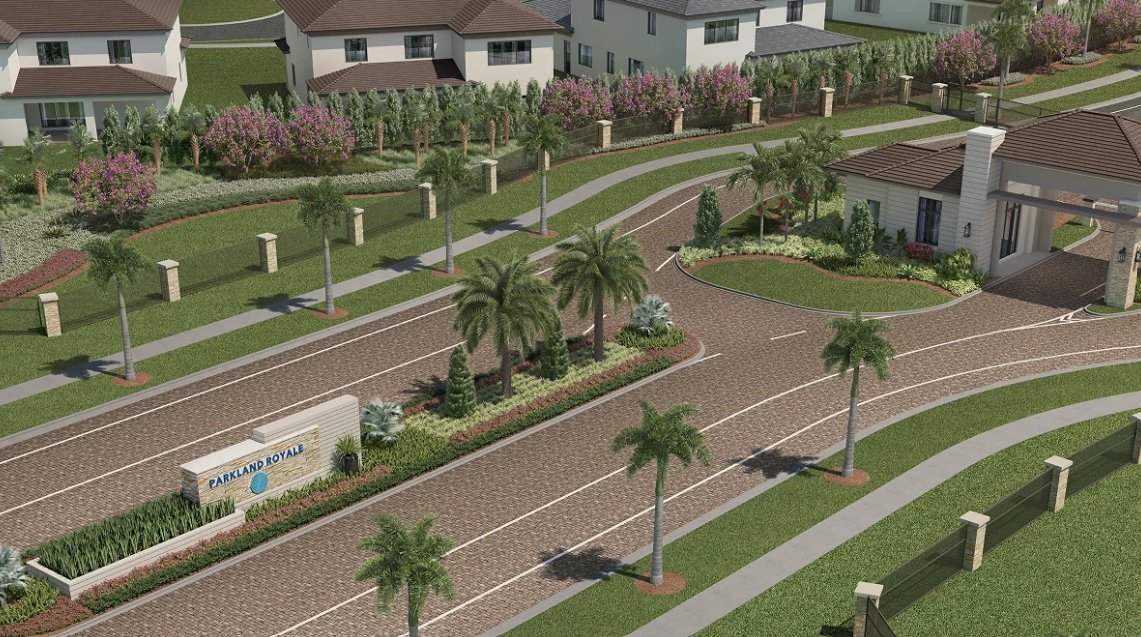
Parkland Royale by Lennar is the community most first-time buyers land in first. It offers some of the smallest, most accessible floor plans currently being built in Parkland, including Next Gen layouts for buyers who need multigenerational flexibility. It’s the closest thing Parkland has to a true entry point right now. A full breakdown of pricing and floor plans is in the Parkland Royale by Lennar Review (2026).
Cascata at MiraLago sits within the larger MiraLago master plan and gives buyers a gated, amenity-rich community without the estate-home price tag of the neighborhood’s larger single-family sections. It’s a step up from the absolute floor but still well under the citywide median.
Saltgrass at Heron Bay is inside one of Parkland’s most established master-planned communities, Heron Bay, which already has the golf course, the clubhouse, and the school reputation baked in. Buying into Saltgrass gets you the Heron Bay address at a smaller footprint and lower entry price than the resale estate homes around it.
All three of these are new construction, which matters for a first-time buyer in a specific way: builder financing incentives, warranty coverage, and predictable HOA structures that you don’t get chasing a 2005-built resale home that’s about to need a roof. There’s a second, quieter advantage too. New construction in these communities comes with a builder’s structural warranty, typically covering major systems for the first year and structural elements well beyond that. A first-time buyer stretching to hit the price floor usually doesn’t have a large cash cushion sitting behind the down payment. Not needing to budget for a roof, an AC system, or a water heater in year one or two is a real part of what you’re paying for, even though it never shows up as a line item on the listing sheet. For the fuller list of what’s actively being built and sold right now, see New Construction in Parkland: What Is Available in 2026.
The Tax Bill Nobody Shows You Before You Sign
This is the part that catches first-time buyers off guard more than anything else, and it hits hardest at the entry level because the percentage swing feels bigger relative to a smaller budget.
Florida has the Save Our Homes cap, which limits how much a homesteaded property’s assessed value can climb each year, capped at the lesser of 3% or the CPI. Over years of ownership, that creates a growing gap between what a home is actually worth on the market and what the seller has been paying tax on. Great deal for the seller. Here’s what almost nobody explains to a first-time buyer before closing: that cap resets completely the moment the property sells.
That means you don’t inherit the seller’s tax bill. You get a fresh assessment based on what you paid. On a $1.15 million Parkland home, that reset can push a year-one tax bill to roughly $21,153 before any exemptions are applied. Scale that down to a $700,000 to $750,000 entry-level purchase and you’re still looking at a first-year tax bill in the $13,000 to $14,000 range, which is a very different number than whatever the last owner’s property tax history showed on the listing.
Walk through what that actually does to a monthly payment. A $13,500 annual tax bill breaks down to $1,125 a month, escrowed alongside principal and interest. Compare that to a resale listing where the seller has owned the home for eight years under the Save Our Homes cap, showing a tax history of maybe $7,800 a year, or $650 a month. That’s a $475 monthly gap between what the listing portal shows as “estimated payment” and what you’ll actually be billed once the county reassesses the property in your name. Multiply that gap over a 30-year mortgage and you’re looking at over $170,000 in additional tax exposure that a Zillow or Redfin estimate simply doesn’t capture, because those tools pull the seller’s current tax bill, not your future one.
For a first-time buyer stretching to hit the Parkland price floor, this is the number that actually breaks a monthly budget, not the mortgage payment. Run the actual year-one number with your lender before you fall in love with a floor plan, not the number the seller was paying. Ask your lender specifically to run the escrow using a reassessed value at your purchase price, not the trailing tax history pulled from the county record. Most lenders will do this if you ask, but very few volunteer it unless you push for it.
HOA and CDD: The Payment That Doesn’t Show Up in the Mortgage Calculator
Nearly all of Parkland’s inventory, including every entry-level new construction community, is gated with mandatory HOA dues. A lot of these communities also carry a separate Community Development District (CDD) assessment stacked on top of the HOA, which pays down the infrastructure bonds that built the roads, gates, and amenities in the first place.
For a first-time buyer comparing a $700,000 townhome in Parkland to a similarly priced home in Coral Springs or Coconut Creek, the HOA and CDD combination can add several hundred dollars a month that never shows up when you run a basic mortgage calculator online. That’s on top of the property tax reset above. Add it up: principal and interest, the reset tax bill, HOA, and CDD, and the “affordable” entry-level unit can carry a monthly number that’s closer to a $900,000 home in a neighboring city with none of those extra assessments.
Here’s a concrete way to picture it. If a community’s HOA runs $350 a month and the CDD assessment adds another $250 a month, that’s $600 a month, or $7,200 a year, before you’ve paid a dollar toward principal. Over a ten-year hold, that’s $72,000 in payments that build zero equity, on top of whatever the tax reset has already added. None of this means skip these communities. It means budget the real number, not the number on the listing sheet, and ask specifically whether a CDD is active and what year it’s scheduled to be paid off before you write an offer. Some CDD bonds are structured to retire in fifteen to twenty years, at which point that piece of the assessment drops off. Others are newer and have decades left. That single question, asked to the builder or the listing agent before you go under contract, can change your real monthly number by hundreds of dollars.
The School Premium: What You’re Actually Buying
This is the entire reason most first-time buyers are looking at Parkland in the first place, so it deserves a straight answer instead of a vague one.
Parkland sits inside Broward’s most consistently high-performing public school zone, anchored by schools that routinely outperform county averages, and that reputation is real, not marketing. Families move to Parkland specifically to get their kids into that pipeline, and the demand it creates is a direct driver of the price-per-square-foot premium documented above. You are, in a very literal sense, paying $100 to $150 more per square foot than Coral Springs partly to buy into that school zone.
Here’s the honest test for whether that premium is worth it at entry level: are you buying this home for a child who is enrolled or about to be enrolled in the next one to two years? If yes, the premium is buying something concrete and immediate. If you’re a first-time buyer without kids yet, or with kids years away from school age, you’re paying today’s premium for a benefit you might not use for five or more years, during which the same money could build equity in a lower-cost home in Coral Springs, Coconut Creek, or Tamarac, with the option to move into Parkland later once the school need is actually current.
Think through two versions of the same buyer to see how differently this plays out. Buyer A has a five-year-old starting kindergarten in the fall. They stretch to $720,000 for a Parkland Royale townhome, their child is zoned into the school system on day one, and every year they own the home is a year that premium is actively working for them. Buyer B is a newly married couple with no kids yet, planning to start a family in three or four years. If Buyer B stretches to that same $720,000 Parkland townhome today, they’re carrying the full tax reset, HOA, and CDD load for three or four years before the school zone matters to them at all, with no offsetting benefit during that stretch. Buyer B is usually better served buying in Coral Springs now, building equity at a lower monthly carry, and reassessing the move to Parkland once there’s an actual child approaching school age. For more on what daily life and the broader value proposition look like once you’re in, Living in Parkland, Florida (2026): Schools, Cost of Living, and Is It Worth It? covers the full picture beyond just the school question.
A Framework for Deciding: Is the Premium Worth It for You?
Strip out the emotion and run it as a decision, not a feeling. Here’s the framework:
1. Timeline to use the schools. Under two years to enrollment, the premium is buying something real. Five-plus years out, you’re pre-paying for a benefit that may not still apply the way it does today, and you’re carrying that cost the entire time.
2. Total monthly carry, not listed mortgage payment. Add principal and interest at the full reset tax assessment, plus HOA, plus CDD if applicable. Compare that real number against the same math in Coral Springs or Cooper City before deciding Parkland is “close enough” in price. Ask your lender to write out the full number on paper, not just the number that shows on the pre-approval letter, which typically uses the seller’s outdated tax history.
3. How long you’ll actually stay. New construction closing costs, the tax reset, and CDD assessments all amortize better the longer you own. A first-time buyer planning to move again in three years absorbs those costs at a much worse rate than one planning to stay seven to ten years. If you know you’re a short-timer, the math almost never favors Parkland’s entry level over a lower-cost neighboring city.
4. What you’re giving up on space. At $369 to $403 a square foot, your entry-level dollar in Parkland buys meaningfully less square footage than the identical dollar in Cooper City or Davie. If square footage and yard size matter more to your family than the specific school zone, that tradeoff needs to be made consciously, not discovered after closing.
5. Whether you actually need Parkland specifically, or just the corridor. Coral Springs borders Parkland directly and runs $254 a square foot instead of $369 to $403. If your priority is the general northwest Broward lifestyle, good schools, low crime, family-oriented communities, without requiring the Parkland zip code specifically, you have real options nearby at a lower entry cost.
Run all five of these on paper before you tour a single model home. It takes twenty minutes and it will save you from making an emotional decision on a walkthrough, standing in a bright, staged model kitchen with a sales rep telling you units are moving fast. Units in Parkland do move fast. That’s not a reason to skip the math.
Who Should Buy at Entry Level in Parkland, and Who Shouldn’t
Buy now if: you have a child entering the school system within the next two years, you’re planning to stay seven-plus years to let the tax reset and closing costs amortize, and you’ve run the real monthly number including the tax reset, HOA, and any CDD, and it still fits comfortably.
Wait or look elsewhere if: you’re years away from needing the school zone, you’re planning a shorter hold, or the entry-level price in Parkland is stretching your budget to the point where the HOA and CDD stack becomes the difference between comfortable and tight. There’s no shame in buying in Coral Springs or Coconut Creek now, building equity, and moving into Parkland later once the school timeline is actually current. That’s a strategy, not a consolation prize.
If Parkland is still the right call once you’ve run these numbers, start with the communities actually built for this price point rather than competing for scarce entry-level resale inventory. Parkland Royale, Cascata at MiraLago, and Saltgrass at Heron Bay are the three places a first-time buyer’s budget actually has a realistic shot in this market. And if you’re weighing this as a longer-term hold rather than a straight owner-occupied purchase, Parkland Investment Property: The Numbers and the Reality breaks down how the same premium performs when you’re renting instead of living in it.
The Bottom Line
For a first-time buyer, Parkland’s premium is not a myth and it’s not a marketing story, it’s a real, measurable cost difference of roughly $100 to $150 per square foot compared to the cities immediately around it, on top of a property tax reset that can double the number the previous owner was paying, on top of mandatory HOA and, in many communities, a CDD assessment. That premium is worth it when you’re actively using the schools it’s paying for and planning to stay long enough to make the entry costs worth it. It’s a much harder case to make if you’re buying years ahead of needing the schools, on a shorter timeline, or on a budget where the real monthly number, not the mortgage calculator number, is already tight before you factor in the extras. Run the actual math before you fall for the floor plan. That’s the difference between a wise decision and an expensive one.
More articles you might like
Is Cascata at MiraLago Worth It? An Honest Look at GL Homes's Parkland Community
16 min readIs Saltgrass at Heron Bay Worth It? An Honest Look at Toll Brothers's Parkland Community
13 min readIs Parkland Royale Worth It? An Honest Look at Lennar's Guard-Gated Parkland Community
14 min readCascata at MiraLago in Parkland: The New Construction Guide (Floor Plans, Pricing, What to Know)
15 min readParkland Royale Floor Plans Explained (2026): Sizes, Layouts, and Which One Fits
14 min read