Life in Doral: Latin Culture, Golf, Dining, and What Day-to-Day Living Is Like
Life in Doral, Latin culture, golf, dining, and what day-to-day living is like, comes down to one fact most outsiders miss: Doral is not a suburb that happens to have a large Latin population. It is a city that was substantially built by and for that population, and everything from the restaurant menus to the HOA meeting language reflects it. If you are considering a move here, understanding the daily rhythm matters more than the sales brochure version of “family-friendly suburb with golf.” Here’s what it actually feels like to live in Doral in 2026, from the morning school run to what’s actually going up out of the ground right now.
The Latin Culture Is the Foundation, Not a Feature
Doral has earned the nickname “Doralzuela,” and it is not a marketing gimmick. Miami-Dade has one of the largest concentrations of Venezuelan residents outside Venezuela, and Doral is the epicenter. Walk into a Publix on NW 41st Street on a Saturday morning and you will hear more Spanish than English. Local Facebook groups run bilingual, sometimes Spanish-only. School PTA meetings often have Spanish translation built in as a default, not an accommodation.
This shapes daily life in specific ways:
- Business hours and rhythms lean Latin American. Dinner reservations at 8:30 or 9 p.m. are normal, not late. Sunday afternoons are for family, and many local businesses adjust accordingly.
- The professional community is dense. Doral has one of the highest concentrations of international trade, logistics, and corporate offices in Miami-Dade, largely because Venezuelan, Colombian, and broader Latin American business families relocated capital and companies here starting in the 2000s and accelerating through the 2010s.
- It is not just Venezuelan. Colombian, Cuban, Peruvian, and Argentine communities all have a real presence. The result is a genuinely pan-Latin American culture rather than one dominant flavor, which shows up most obviously in the restaurant scene.
If you are relocating from outside South Florida and expect a generic “diverse” suburb, recalibrate. Doral is specifically and unapologetically Latin American in its day-to-day culture, and that is either exactly what you are looking for or a real adjustment.
Here’s a real scenario I run into often: a family relocating from the Northeast for a corporate transfer, no Spanish skills, kids in elementary school. They can absolutely thrive in Doral, plenty of English-speaking families do, but they need to walk in knowing the default social and business language around them is Spanish. It’s not isolating, it’s just a different starting point than a suburb like Weston or Coral Springs. On the flip side, bilingual families relocating from cities like Caracas, Bogota, or even other pockets of Miami often tell me Doral is the first place in the U.S. that felt like home on day one, not after two years of adjustment. That gap in experience is the single biggest thing to know before you buy here. For a full picture of who is actually moving here and why, the Doral, Florida: The Complete Relocation Guide for 2026 breaks down the demographic and lifestyle fit in more depth.
Golf Built the City’s Bones, Even If You Never Play
Doral’s identity is tied to golf in a way few Florida suburbs can match. Trump National Doral, the former Doral Golf Resort and Country Club, put this stretch of Miami-Dade on the map in the 1960s when it hosted what is now the Cognizant Classic’s predecessor events, and the “Blue Monster” course remains one of the most recognized names in American golf.
What this means for day-to-day living:
The Skyline and Street Grid Follow the Fairways
Much of central Doral, including neighborhoods near the resort, was platted around golf course frontage. That means curving streets, cul-de-sacs backing onto fairways, and a premium on “golf view” lots that still commands a real price difference at resale, even for buyers who will never own clubs.
Most Residents Don’t Golf, But Everyone Feels the Economy It Created
Trump National Doral operates as a resort with hotel rooms, event space, and multiple restaurants, which means it pulls in visitor traffic, wedding business, and corporate events that support local service jobs. It is a genuine economic anchor, not just a scenic backdrop.
Golf-Adjacent Living Comes With Tradeoffs
If you buy near a course, expect occasional early-morning maintenance noise, stray golf balls in backyards close to fairways, and HOA rules that can be stricter about landscaping and exterior changes to preserve sightlines. Ask specifically about golf ball liability language in the HOA docs before you buy a fairway-facing lot. I’ve had buyers assume “golf view” automatically means a quiet backyard. Sometimes it means a cart path fifteen feet from your patio and a mower running at 6:45 a.m. Ask to see the lot at that hour before you write the offer, not after.
Trump National is the headline course, but it is not the only one. Doral Park Golf and Country Club offers a more accessible, semi-private option for residents who want to play regularly without resort pricing. For buyers who golf occasionally but don’t want to carry a country club membership fee every month, that distinction matters more than it looks like on paper.
The Dining Scene Is Genuinely One of Miami-Dade’s Best
This is where Doral separates itself from other master-planned Miami-Dade suburbs. NW 41st Street between roughly 87th Avenue and 107th Avenue, along with the Downtown Doral core and CityPlace Doral, has become one of the densest concentrations of Latin American restaurants in the county.
What You’ll Actually Eat on a Weeknight
- Venezuelan: Arepa spots and full-service Venezuelan restaurants are everywhere, serving pabellon criollo, cachapas, and tequeños as standard weeknight fare, not special-occasion food.
- Colombian: Bandeja paisa and empanada shops sit a few doors down from Venezuelan spots, often in the same strip plazas.
- Peruvian: Ceviche and lomo saltado spots have grown fast alongside the broader Peruvian food boom across South Florida.
- Pan-Latin fusion: A newer wave of restaurants blends Latin American technique with a more polished, date-night presentation, particularly in Downtown Doral and CityPlace Doral.
CityPlace Doral and Downtown Doral Are the Social Hubs
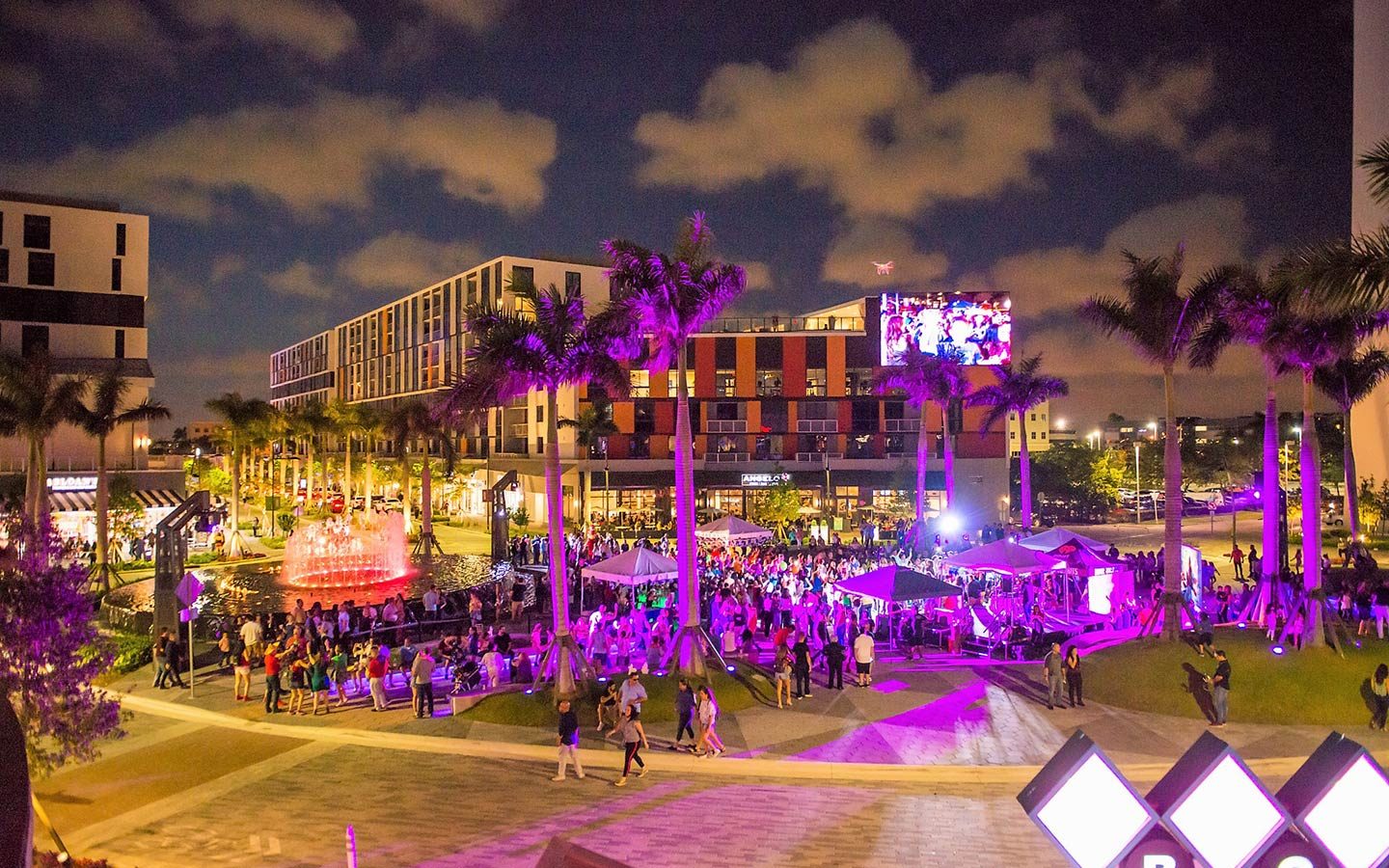
CityPlace Doral functions as an open-air lifestyle center with restaurants, a movie theater, and retail, and it draws residents from well beyond Doral’s borders on weekend nights. Downtown Doral, built around Downtown Doral Park, layers residential density (condos and townhomes) directly on top of walkable restaurant and retail space, which is the closest thing Doral has to true live-work-play urbanism. If daily walkability to dinner matters to you, this is the part of the city to focus your search on, and it is covered in more detail in Doral Neighborhoods: Downtown Doral, Doral Isles, and Where to Live.
Practical Notes for New Residents
Reservations matter at the popular spots on weekend nights, parking in CityPlace Doral fills up fast after 7 p.m., and cash is still preferred at some smaller family-run restaurants even though card is universally accepted. If you’re new to the area, a simple habit that saves headaches: book weekend dinner reservations by Wednesday for the popular spots in Downtown Doral, and plan on street parking or a short walk if you’re eating in CityPlace Doral after 7 p.m. It’s not a dealbreaker, it’s just the reality of a dining corridor that’s outgrown its original parking footprint.
What a Typical Day-to-Day Actually Looks Like
Doral is a working suburb, not a retirement community or a purely bedroom suburb. Understand the real rhythm before you commit.
The Commute Reality
Doral sits between the Palmetto Expressway (SR 826) to the east, the Florida Turnpike to the west, and the Dolphin Expressway (SR 836) cutting through the middle, which gives it genuinely strong highway access to Miami International Airport, Brickell, and Miami Beach. That said, NW 41st Street and NW 58th Street both see heavy congestion during school drop-off and evening rush hour, and 836 backs up predictably during peak commute windows. Budget 25 to 40 minutes to Brickell depending on time of day, and closer to 15 minutes to MIA, which is one of Doral’s biggest daily-life advantages for residents who travel frequently for business. For a household with one parent flying out weekly for work, that 15-minute airport run alone can be worth more than a slightly larger backyard somewhere further west. It’s the kind of tradeoff worth mapping against your actual weekly schedule, not just a listing sheet.
Errands and Daily Logistics
Doral has dense retail coverage. Multiple Publix locations, a Costco, and international grocery options (including specialty Venezuelan and Colombian markets) mean you rarely need to leave the city for groceries. The downside is that daily errands are still mostly car-dependent outside Downtown Doral and CityPlace Doral. Sidewalks exist throughout most residential communities, but genuine walk-to-everything living is limited to those two pockets. If you’re coming from a walkable Northeast or Midwest city and expecting to ditch a second car, be honest with yourself about which pocket of Doral you’re buying into first.
Parks and Outdoor Life
Doral Central Park is the anchor green space, with sports fields, a splash pad, and walking trails that see heavy weekday-evening and weekend use from families. Downtown Doral Park does similar duty for the denser residential core. Doral’s flat terrain and extensive sidewalk network in newer communities make it genuinely good for evening walks and jogging, even if it lacks the beach or waterfront access of coastal suburbs. Most weeknights you’ll see the same pattern at both parks: soccer practice starting around 5:30, dog walkers picking up after 6, and the trails filling in once the heat breaks closer to 7. It’s a reliable, predictable rhythm, which is exactly what a lot of relocating families are looking for.
The HOA and CDD Layer
Because so much of Doral was built out through master-planned communities from the 2000s onward, HOA fees and, in some newer developments, CDD assessments are a real part of the monthly budget. Expect HOA fees ranging from roughly $150 to $450+ a month depending on the community and amenity package, with gated communities and those with resort-style pools and clubhouses at the higher end. Newer builds near Westview at Doral carry their own fee structures that buyers should review line by line before making an offer, since amenity-rich master plans often bundle landscaping, security, and clubhouse costs into the HOA rather than leaving them optional.
The New Construction Wave Behind Doral’s Daily Life
Understanding Doral’s day-to-day means understanding what’s actually being built right now, because the price point and product type of new construction shapes who your neighbors are and what your monthly carrying costs look like.
- Park Central Doral (Lennar): Mixed townhomes and condos priced roughly $380,000 to $850,000, with about 400 units in a resort-style master plan built around a grand clubhouse, tennis, and basketball. This is the entry point for buyers who want new construction in Doral without a luxury price tag, and it’s a common landing spot for first-time buyers and young professionals.
- Landmark Doral (Lennar): Luxury townhomes from $700,000 to $1.2 million, gated, three-level modern layouts, and some floor plans with private rooftop terraces. Day to day, this reads as a quieter, more design-forward alternative to the resale stock in older Doral neighborhoods.
- Canarias at Downtown Doral (CC Homes): Single-family estates and townhomes from $900,000 to $2.1 million, walkable to Downtown Doral’s restaurant and retail core, with proximity to Downtown Doral Charter Elementary School as a real draw for families prioritizing school logistics alongside walkability.
- Modern Doral (Lennar): Gated, ultra-modern single-family estates starting at $1.2 million, now in its final construction phases, with expansive floor plans and custom glass facades. This is the top of Doral’s new construction ladder for buyers who want a fully custom-feeling home without leaving the master-planned convenience behind.
- Oasis Park Square (Shoma Group): Boutique luxury townhomes from $1 million, roughly 150 units, with private rooftop patios and summer kitchens, positioned near major highway arteries for buyers who want the commute advantage without sacrificing a upscale finish level.
What this means practically: Doral isn’t a one-price-point suburb. A young professional couple and a family trading up from a $2 million home can both buy new construction in Doral, they just end up in genuinely different day-to-day environments, from a townhome a short walk from CityPlace Doral to a gated estate community with its own private clubhouse. Knowing which tier you’re shopping in before you start touring saves a lot of wasted weekends.
Schools Shape the Daily Calendar for Families
If you have kids, school logistics will dictate a meaningful chunk of your week. Doral is served primarily by Miami-Dade County Public Schools, and the district includes some of the highest-performing public options in the county, which is a major driver of family relocation into Doral specifically. Drop-off and pickup traffic around the more popular schools is genuinely heavy, and it is worth test-driving your prospective daily route during an actual school-day rush hour before buying, not just on a quiet weekend showing. I tell every family the same thing: drive the route at 7:45 a.m. on a Tuesday, not 11 a.m. on a Saturday. The difference in travel time can be fifteen or twenty minutes, and that’s fifteen or twenty minutes you’ll live with every single school day for years. A deeper breakdown of specific schools, zoning, and why families prioritize Doral over other Miami-Dade suburbs is covered in Doral Schools: Why Families Move Here for Miami-Dade’s Best Public Education.
How Doral’s Lifestyle Compares to Nearby Suburbs
Buyers cross-shopping Doral almost always put it up against Weston, and the comparison is useful because the two suburbs solve for different things. Weston leans more suburban-quiet, more tree-canopy, and further from the urban core. Doral leans more urban-adjacent, more bilingual and Latin American in daily culture, and closer to the airport and downtown Miami job centers. Neither is objectively better, but they produce very different day-to-day experiences, and the full side-by-side is worth reading if you are undecided: Doral vs. Weston: Which Western South Florida Suburb Makes More Sense?
Buyers also sometimes compare Doral to Miami Lakes or Pembroke Pines for similar reasons, mainly commute and school quality, but the cultural texture is where Doral pulls away or loses those buyers entirely. If bilingual, Latin American daily life is a plus for your family, nothing else in western Miami-Dade or south Broward replicates it at Doral’s scale. If it’s not a fit, that’s worth knowing before you tour, not after you’ve made an offer.
Who Doral’s Daily Life Actually Fits
Doral works well for:
- Bilingual or Spanish-speaking families who want that culture reflected in daily life, not just as an occasional restaurant outing.
- Professionals with frequent MIA travel or Brickell-area jobs who value the highway access.
- Buyers who want new construction and modern master-planned amenities over older, more established Miami-Dade housing stock.
- People who want walkable dining and retail concentrated in specific pockets (Downtown Doral, CityPlace Doral) without needing full-city walkability.
- Investors who want strong rental demand from young professionals drawn to the international business community, since Doral’s rental market stays consistently active because of that same corporate and trade presence.
It fits less well for buyers who want a quiet, low-density, English-first suburban feel, or who prioritize direct beach or waterfront access over commute convenience and dining density. If you are early in your search and still weighing whether Doral’s new construction inventory and price points make sense for your budget, New Construction in Doral: What Is Available and What It Costs and First-Time Buyer in Doral: New Construction, Schools, and What to Expect both go deeper into the numbers behind the lifestyle described here.
The Bottom Line
Life in Doral, Latin culture, golf, dining, and what day-to-day living is like, is best understood as a package deal: you get a genuinely bilingual, Latin American-anchored community, a golf-shaped street grid and resort economy most residents interact with only occasionally, one of Miami-Dade’s strongest Latin dining corridors, a new construction market that spans from $380,000 townhomes to $2 million-plus estates, and a car-dependent but increasingly walkable daily routine centered on Downtown Doral. It is not a generic Florida suburb, and it does not try to be. If that specific combination matches what you are looking for, Doral delivers it more consistently than almost anywhere else in Miami-Dade.
If you want the numbers behind the lifestyle, current pricing, HOA ranges, and rental performance for investors are covered in Doral Investment Property: Rental Market and Returns in 2026, and current market conditions are tracked in the Doral Real Estate Market Update: Prices and Conditions in Mid-2026. DM me “DORAL” and I will send you a current list of what is actively selling and what fits your budget.
More articles you might like
Is Westview at Doral Worth It? An Honest Look at Lennar's Doral Community
13 min readWestview at Doral in Doral: The New Construction Guide (Floor Plans, Pricing, What to Know)
14 min readWestview at Doral Review (2026): Prices, Floor Plans, HOA, CDD, and Who It's For
13 min readDoral vs Coral Gables: Two Very Different Versions of Miami-Dade Living
17 min readDoral vs. Weston: Which Western South Florida Suburb Makes More Sense?
13 min read