Doral Schools: Why Families Move Here for Miami-Dade's Best Public Education

Doral schools are the real reason a lot of families end up buying here instead of Weston, Pembroke Pines, or Palmetto Bay. The short answer to “doral schools why families move here for miami-dade’s best public education”: it’s the combination of Doral Academy’s charter network, Ronald W. Reagan/Doral Senior High’s IB program, and a newer housing stock where builders design entire communities around walkable school access. That’s not marketing. That’s how the city actually functions.
Miami-Dade County Public Schools is enormous, over 330,000 students, and quality varies block by block. Doral is one of the few pockets in the county where the school conversation is simple instead of complicated. You’re not choosing between one decent option and five you’d avoid. You’re choosing between several strong ones, and the harder question is usually zoning and lottery odds, not quality.
I hear a version of the same conversation almost every month from relocation buyers: they found a house they love, they assume the school situation will sort itself out, and then they call me three weeks later asking why their real estate agent didn’t mention the lottery. Doral rewards buyers who do the school homework before they write an offer. It punishes buyers who treat it as an afterthought. This guide is the homework.
What Makes Doral’s School System Different
Most of Miami-Dade runs on traditional zoned public schools. Doral runs on a hybrid: zoned Miami-Dade County Public Schools sitting right next to a dense cluster of charter schools, most of them under the Doral Academy or Academir umbrellas. Charter schools in Florida are still public, still tuition-free, still funded through the state. What’s different is governance. They operate under their own boards, often with more flexibility on curriculum, uniforms, and school culture, and they usually have enrollment caps and lottery admission instead of a hard boundary line.
This matters for buyers because it changes the calculation. In most suburbs, “which school will my kid attend” is answered by your address alone. In Doral, it’s answered by your address plus whether you get into the lottery, plus whether you’re willing to drive to a campus outside the zone. Families who understand this ahead of time make better decisions. Families who don’t often end up disappointed after closing.
Picture two families buying the same month, both relocating from out of state, both with a rising kindergartner. Family A picks a house because the listing mentions “zoned for excellent schools,” assumes that settles it, and closes without confirming anything further. Family B calls the specific campus, confirms the current boundary and lottery rules in writing, and picks a house based on the actual answer, not the general reputation. Family A finds out in July that their preferred charter campus is full for the year and they’re on a waitlist with no guaranteed timeline. Family B already knew that risk existed and built a backup plan into their house search. Same city, same budget range, completely different outcome, and the difference was ten minutes of research before the offer, not after.
If you’re relocating from out of state, this is one of the first things to sort out before you fall in love with a house. Our Doral, Florida: The Complete Relocation Guide for 2026 walks through the broader relocation picture, but schools deserve their own deep dive because they drive so much of the buying decision here.
Doral Academy: The Charter Network Families Chase
Doral Academy is the name most people mean when they say “Doral schools.” It’s not one school. It’s a network of charter campuses across the city, generally including elementary, middle, and preparatory (high school) options, each with its own address, boundary, and admissions process.
What families consistently like about Doral Academy:
- Academic consistency. The network has built a reputation over more than a decade for solid academic performance, which is unusual for a charter system operating at this scale.
- Smaller campus feel. Even though enrollment is large citywide, individual campuses tend to feel more contained than a typical Miami-Dade zoned school with 1,500+ students.
- Structure. Uniforms, consistent discipline policies, and a culture that leans traditional. Some families want that. Some don’t. Know which one you are before you commit to a house near a specific campus.
The catch: Doral Academy campuses have real enrollment caps. Getting in isn’t automatic just because you bought a house nearby. Some campuses give geographic priority in their lottery, but priority isn’t a guarantee. Sibling preference is usually the strongest factor if you already have a child enrolled, followed by employee preference, then geographic zone, then general lottery. If none of those apply to you, you’re competing in the open pool, and open pool odds can be tight at the more established campuses.
Applications typically open well before the school year starts, and waitlists move throughout spring and summer as families confirm or decline seats elsewhere. That timing matters for relocation buyers specifically. If you’re moving in June for a July closing, you may already be behind families who applied back in January. If a specific Doral Academy campus is the reason you’re buying in a certain part of the city, call the school directly and get the current lottery rules, application windows, and waitlist movement history in writing before you go under contract. Rules change year to year, and an agent’s memory of “how it worked two years ago” isn’t good enough for a decision this size.
Ronald W. Reagan/Doral Senior High School and the IB Track
For high school, most of Doral zones into Ronald W. Reagan/Doral Senior High School. It’s a traditional Miami-Dade County Public School, not a charter, and it’s one of the district’s stronger comprehensive high schools. The headline feature is the International Baccalaureate program, a rigorous, internationally recognized curriculum that’s genuinely harder to get into and harder to complete than standard honors coursework.
Families relocating from competitive school districts up north (Westchester, the DC suburbs, parts of New Jersey) often ask if Doral has “a real AP or IB pipeline” or if South Florida schools are a step down academically. Reagan is usually the answer that puts that concern to rest. Between the IB diploma track, standard AP offerings, and dual enrollment options through Miami Dade College, a motivated student has real academic runway here without needing a private school.
Dual enrollment deserves its own mention because it’s underused by relocation families who don’t know it exists. A Reagan student who plans well can walk out of high school with a stack of college credit already banked through Miami Dade College, at a fraction of what those same credit hours would cost at a four-year university. For families thinking long-term about the total cost of raising a kid in South Florida versus wherever they’re coming from, that’s a real number, not a soft benefit.
The tradeoff with any large zoned public high school: it’s big. If your kid thrived in a small private school environment, Reagan’s scale is worth touring in person before you assume it’s the right fit. Bigger isn’t automatically worse, but it is different, and different matters for some kids more than others. Ask about class sizes in the IB track specifically, since those cohorts tend to run smaller than the general population even inside a large school, which softens the scale concern somewhat for families chasing rigor over size.
Elementary and Middle School Options Beyond Doral Academy
Doral Academy gets the attention, but it’s not the only strong option, and treating it as the only option is a mistake I see relocation buyers make constantly.
Eugenia B. Thomas K-8 Center is a traditional Miami-Dade zoned school serving Doral, running kindergarten straight through eighth grade under one roof. A K-8 structure means fewer transitions for your kid, which some families specifically look for. Instead of moving buildings, campuses, and social circles at fifth grade the way a traditional elementary-to-middle split forces, a K-8 kid stays in one community for nine years. For families who relocated once already and don’t want their kid absorbing another disruption mid-childhood, that stability is worth factoring into the house search.
Downtown Doral Charter Elementary School sits inside the Downtown Doral master plan and is a magnet for families buying in that specific pocket of the city, including newer product like Urbana at Downtown Doral and the surrounding CC Homes communities. If you’re looking at single-family or townhome product in that corridor, this is the elementary school most sellers will bring up unprompted, because proximity to it genuinely moves buyer interest. I’ve had listings in that zone where “walking distance to the elementary school” did more work in the showing than the kitchen renovation.
Doral Middle School is the traditional zoned middle school option for families not pursuing the Doral Academy lottery. It doesn’t get the same buzz, but it’s a functional, adequate option for families who’d rather not deal with charter admissions uncertainty. For a lot of families, that trade, giving up some of the charter polish in exchange for a guaranteed seat with no lottery risk, is the right call. There’s nothing wrong with choosing certainty over prestige when it comes to your kid’s school placement.
The pattern across all of these: Doral doesn’t have “the one good school and everything else is a fallback.” It has multiple credible paths, which is exactly why school quality alone doesn’t fully explain why a family should pick one Doral neighborhood over another. That decision comes down to which specific school your address feeds into, and what the commute and lifestyle look like around it. Our Doral Neighborhoods: Downtown Doral, Doral Isles, and Where to Live in 2026 breaks that down street by street.
The Boundary Risk Nobody Tells You About
Here’s the part most agents skip because it’s inconvenient to bring up mid-showing: school boundaries are not permanent. In Broward, Miami-Dade, and Palm Beach alike, zoning lines get redrawn, sometimes because a new school opens, sometimes because a neighborhood grew faster than the district planned for. A house that’s zoned for Reagan or feeds a strong K-8 center this year isn’t contractually guaranteed to stay that way five years from now.
This is a bigger deal in Doral specifically because the city is still building. New construction adds households faster than most established Broward suburbs, and Miami-Dade County Public Schools has had to respond with boundary adjustments before and will likely do it again. When a district adds hundreds of new homes to a corridor that was already near capacity, something has to give, and that something is usually the boundary map. It’s not a Doral-specific flaw. It’s just math. More rooftops eventually means redrawn lines somewhere in the district, and there’s no way to predict exactly which streets get moved until the district actually votes on it.
If school zoning is the primary reason you’re buying a specific address, don’t rely on a listing description or an agent’s verbal assurance. Pull the current boundary map from Miami-Dade County Public Schools directly, and ask when it was last updated. Ask specifically whether any boundary changes are under discussion or scheduled for a future school year, since some adjustments are announced well ahead of the actual change. A five-minute check now beats an unpleasant surprise before third grade starts.
New Construction Communities Built Around School Access
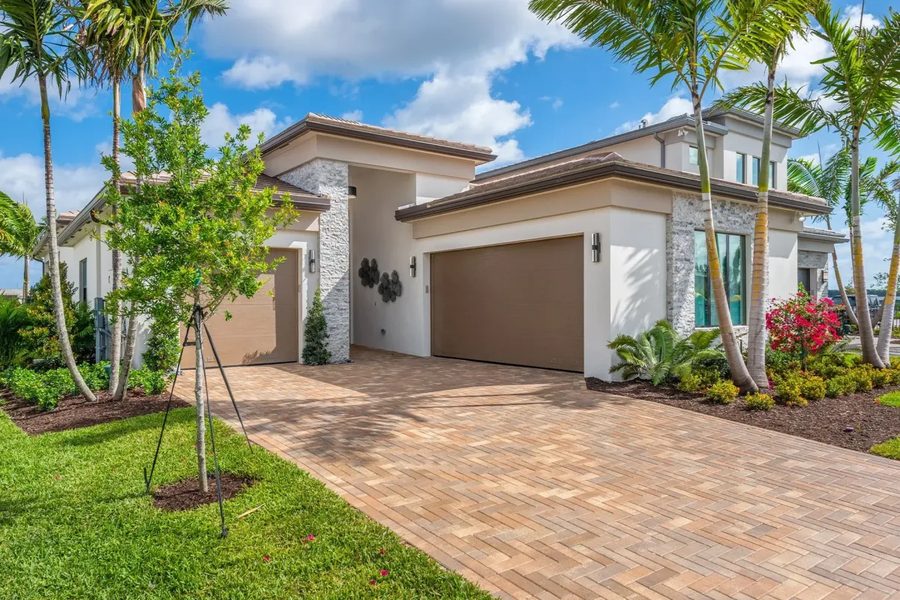
Builders in Doral know schools sell houses, so a lot of newer product is positioned deliberately around them. Westview at Doral is one of the newer communities where family buyers weigh school proximity alongside price and floor plan, and it’s worth a look if you’re comparing new construction against resale in the same school zones.
Downtown Doral’s master-planned communities, Park Central Doral, Landmark Doral, Canarias, and Modern Doral among them, market their walkability to Downtown Doral Charter Elementary as a core feature, not an afterthought. Prices in that corridor run wide: Park Central starts around $380,000 for townhome and condo product across roughly 400 units, Landmark Doral’s gated luxury townhomes run $700,000 to $1,200,000 across about 350 units, Canarias at Downtown Doral single-family estates run from roughly $900,000 up past $2,100,000, and Modern Doral’s gated single-family enclave starts around $1,200,000 in its final construction phases. Oasis Park Square, a boutique townhome community from Shoma Group, adds another option starting around $1,000,000, with private rooftop patios and summer kitchens for buyers who want upscale product without the single-family price tag.
The spread tells you something useful: you don’t need the highest price point in Doral to buy into a strong school zone. You need to know which specific development feeds which specific school, because “Downtown Doral” as a label covers a wide range of both price and zoning. A townhome buyer at Park Central and an estate buyer at Canarias may end up zoned for the exact same elementary school despite a price gap of well over a million dollars. That’s useful leverage if you’re trying to buy into a specific school zone without overspending on square footage you don’t need.
One more thing to factor into your monthly budget in these communities: HOA fees and, in some newer developments, CDD assessments layer on top of the mortgage payment. A $380,000 townhome with a $450 monthly HOA fee and no CDD carries very differently than a $1,200,000 estate with a lower percentage HOA fee but an added CDD assessment. Run the full monthly number, not just the price tag, before you compare communities against each other.
If you’re weighing new construction against an established resale neighborhood, our New Construction in Doral: What Is Available and What It Costs and First-Time Buyer in Doral: New Construction, Schools, and What to Expect guides go deeper on inventory and what you actually get at each price band.
Private and Specialized School Options
Not every Doral family goes the public or charter route, and it’s worth knowing what’s available if a public school seat falls through or doesn’t fit your kid’s needs. Doral has a handful of private schools serving the area, generally smaller in scale than the public options and typically running religious or specialized curriculum. Some families choose private specifically as a fallback if a charter lottery doesn’t come through, rather than as a first choice, which means demand and tuition can shift depending on how the public lottery landscape looks that year.
If private school is part of your plan regardless of address, factor tuition into your housing budget from the start rather than treating it as a variable you’ll figure out later. It changes what “affordable” actually means for your household. A family comfortable at a $600,000 purchase price with public school tuition costs of zero has a very different real monthly budget than the same family paying five figures a year per child in private tuition. Get a real tuition quote from the specific school you’re considering before you set your house budget, not after.
How School Access Affects Home Prices in Doral
Doral’s school reputation isn’t just a lifestyle perk, it shows up directly in resale value. Homes within an easy walk or short drive of Downtown Doral Charter Elementary, or zoned confidently for Reagan’s IB track, tend to hold value better and sell faster than comparable product further from those anchors. This is one of the reasons Doral has stayed resilient even as parts of Miami-Dade have cooled. School-driven demand is stickier than lifestyle-driven demand alone, because families with kids in a specific school are far less likely to move mid-enrollment than a childless buyer chasing the next hot corridor.
I’ve watched two nearly identical listings in Doral sit on the market for very different lengths of time because of this exact factor. Same square footage, same finish level, same list price range, but one was a confirmed walk to Downtown Doral Charter Elementary and the other was a short drive to a school outside the charter network. The walkable listing moved in under three weeks. The other took closer to two months and needed a price adjustment to get there. That’s not a coincidence. Buyers with school-age kids do the zoning homework before they ever call an agent, and they act fast when a listing checks that box.
For buyers thinking about this as an investment, not just a place to live, that stickiness matters. Renters and future buyers will ask the same zoning questions you’re asking now. A property with a clear, defensible answer rents and resells easier. Our Doral Investment Property: Rental Market and Returns in 2026 piece covers how school access factors into rental demand specifically.
Doral vs. Other Western Suburbs for Schools
Doral gets compared constantly to Weston, and the school conversation is usually where that comparison gets decided. Weston has its own strong reputation, built more on traditional zoned Broward public schools with less charter density than Doral. Doral’s edge is variety and a genuinely competitive charter option in Doral Academy. Weston’s edge is a longer track record and larger, more established campuses. Neither is objectively better across the board, it depends on whether your family wants charter flexibility or the predictability of a long-standing zoned system. We laid out the full comparison, cost of living included, in Doral vs. Weston: Which Western South Florida Suburb Makes More Sense?
Pembroke Pines and Palmetto Bay come up in these conversations too, usually from families cross-shopping across county lines. Pembroke Pines runs on Broward’s zoned system with a handful of respected charter options mixed in, but nowhere near Doral’s charter density. Palmetto Bay leans almost entirely zoned, with families paying a premium for specific elementary boundaries the way you’d expect in an older, more established Miami-Dade suburb. If you want the widest range of school choice packed into one relatively small city, Doral is genuinely the strongest option among the four. If you want a longer-established, single-path zoned system with less lottery uncertainty, Weston or Palmetto Bay may fit your family’s comfort level better. There’s no wrong answer here, only a wrong fit if you buy without understanding which system you’re actually opting into.
What This Means If You’re Relocating for Schools
If schools are the deciding factor in your move, here’s the actual process, not the shortcut version:
- Identify the specific school, not just the city. “Doral schools” is not specific enough to buy a house against. “Doral Academy Elementary at this address” or “zoned for Reagan” is.
- Confirm current boundaries directly with Miami-Dade County Public Schools, not through a listing agent’s memory.
- Ask about lottery odds if you’re targeting a charter campus, and have a backup zoned school in mind in case you don’t get in. Ask specifically about sibling preference, geographic priority, and how many names are currently on the waitlist for your target grade.
- Tour in person. Ratings and reputation change slower than reality on the ground. A five-minute drive-by during pickup or drop-off tells you more than any review site.
- Budget for the whole picture, not just the mortgage. HOA fees in Downtown Doral communities and CDD assessments in some newer developments affect your real monthly number, and that number needs to work whether or not the school lottery goes your way.
- Have a plan B house, not just a plan B school. If your top-choice campus doesn’t come through, know in advance which second neighborhood still gets you a school you’d be genuinely happy with, not one you’re settling for out of frustration mid-move.
The reality is Doral earned its reputation as a school-focused city because the infrastructure actually backs it up: a strong charter network, a real IB high school, and builders who design communities around school access instead of bolting it on as an afterthought. That’s rare in Miami-Dade. It’s not rare enough that you can skip the homework, though. Confirm zoning, confirm lottery rules, and buy the house that matches the school you actually want, not the city’s general reputation.
If you’re relocating and want the zoning confirmed for a specific address before you tour, message me the neighborhood or listing and I’ll pull the current boundary information directly.

More articles you might like
Is Westview at Doral Worth It? An Honest Look at Lennar's Doral Community
13 min readWestview at Doral in Doral: The New Construction Guide (Floor Plans, Pricing, What to Know)
14 min readWestview at Doral Review (2026): Prices, Floor Plans, HOA, CDD, and Who It's For
13 min readDoral vs Coral Gables: Two Very Different Versions of Miami-Dade Living
17 min readDoral vs. Weston: Which Western South Florida Suburb Makes More Sense?
13 min read