Mangonia Park, FL Real Estate Market 2026: Prices, Trends & What Buyers Should Expect
Mangonia Park home prices in 2026 mostly land between $300,000 and $460,000 for a resale single-family home, with a small number of manufactured homes trading under $200,000. That is the short answer. The longer answer, the one that actually matters if you are deciding whether to buy here, is about what kind of town Mangonia Park is, what you are actually buying next to, and whether the trade-offs make sense for your situation. This is the mangonia park fl real estate market 2026 prices trends what buyers should expect breakdown, written for people who are seriously considering it, not for people scrolling past.
Mangonia Park doesn’t get talked about much because it’s easy to overlook. It’s a little over one square mile, wedged between West Palm Beach and Riviera Beach, with a population that hovers around 2,000 to 2,500 people. Most of the town’s land is zoned industrial or commercial. Homes are the minority use here, not the majority. That single fact explains almost everything else about the market: the pricing, the inventory, the buyer profile, and the risk you’re accepting when you put an offer in.
Most buyers find this town by accident. They’re searching Zillow with a price cap around $400,000, zoomed into the West Palm Beach area, and a handful of listings pop up in a place they’ve never heard of. That’s a fair way to discover it, but it’s not enough information to decide on it. You need to understand the shape of the town before you understand the shape of the deal.
Where Mangonia Park Actually Sits
Mangonia Park is bordered roughly by Australian Avenue to the west, Haverhill Road area to the east, 45th Street (Community Drive) to the north, and the West Palm Beach city line to the south. It sits directly east of I-95, which means residents get one of the fastest commutes into downtown West Palm Beach anywhere in the county, usually under 10 minutes with no traffic. Palm Beach International Airport is a similarly short drive, roughly 10 to 15 minutes depending on the route.
The town also hosts the Mangonia Park Tri-Rail and Amtrak station, which was historically the northern terminus of the Tri-Rail line before service extended further north. That station matters more than people realize. It’s one of the few places in Palm Beach County where you can genuinely commute by rail to Fort Lauderdale, Miami, or south toward Boca Raton without needing a car for the trip. For a buyer who works downtown or in Brickell and doesn’t want to own a second car, that station alone can justify looking here when it wouldn’t otherwise make the list.
What you won’t find here is a downtown, a walkable retail corridor, or a masterplanned community gate. Mangonia Park’s identity is functional. It’s a small municipal government (its own town council and its own police department) sitting on top of a landscape dominated by warehouses, distribution centers, contractor yards, and older residential streets that predate most of the industrial buildout around them.
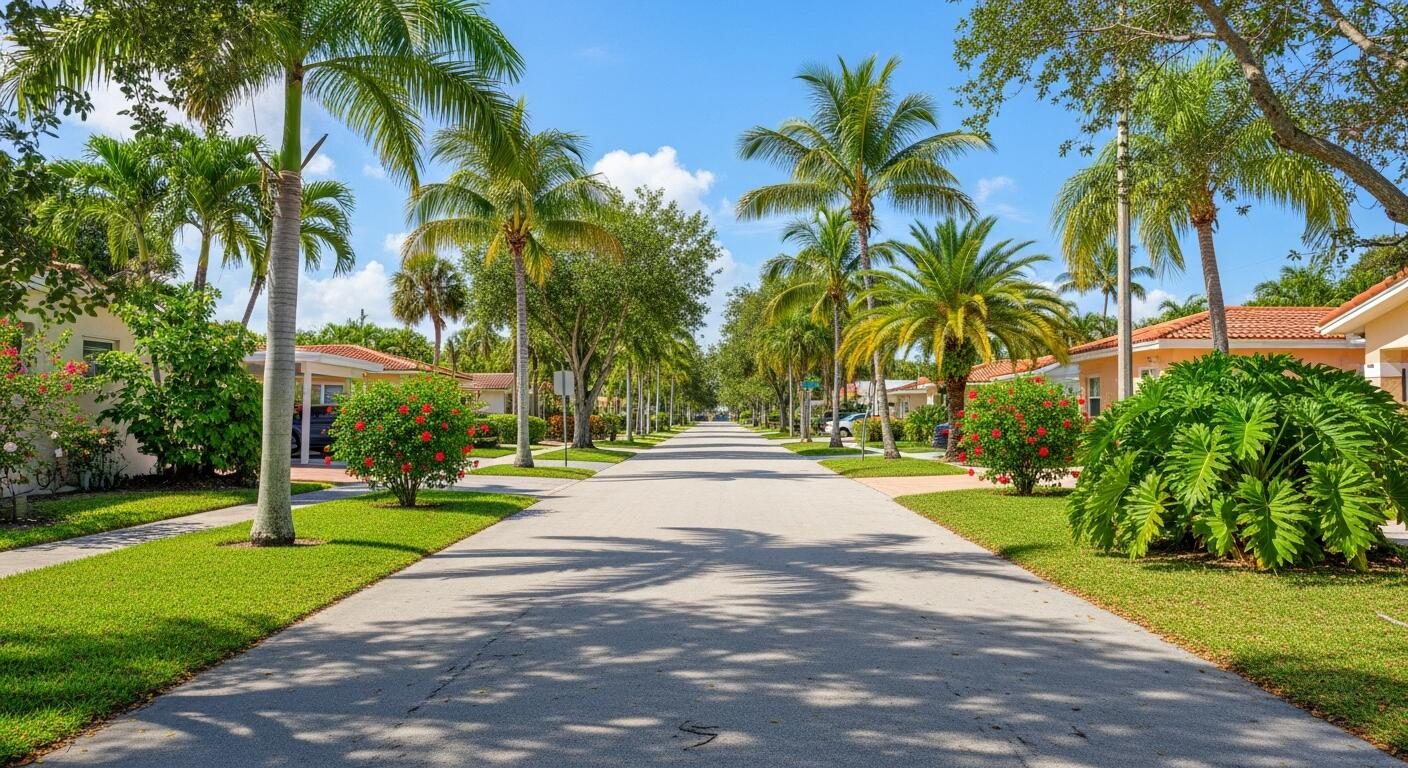
Drive it once before you form an opinion from satellite view. Australian Avenue itself is almost entirely commercial and industrial, forklifts, loading docks, tractor trailers staging for pickup. A block or two east, on streets like Cherry Road, Pinewood Avenue, or the residential grid closer to Congress Avenue, the feel changes. Older single-story homes, mature trees, driveways with boats and work trucks parked in them. It’s not manicured, but it’s lived-in, and it’s a different world from the industrial frontage a few hundred yards away. That contrast, block to block, is the single most important thing to understand about this town before you get attached to a listing photo.
Mangonia Park FL Real Estate Market 2026: Prices, Trends & What Buyers Should Expect
Here is where the numbers actually shake out in 2026, broken down by what you’re realistically going to find on the market.
Single-family resale homes
The bulk of Mangonia Park’s housing stock is concrete block construction (CBS) built in the 1950s through the 1970s, on modest lots typically between 0.15 and 0.25 acres. A smaller 2-bedroom, 1-bathroom home in original or lightly updated condition generally lists in the $280,000 to $350,000 range. A larger, renovated 3-bedroom, 2-bathroom home with newer kitchens, updated electrical, and a newer roof can push into the $380,000 to $460,000 range. There is very little in between and very little above that ceiling, because there simply aren’t large, newer homes here to compare against.
Square footage on most of these homes runs 900 to 1,600 square feet, well under what a buyer coming from a newer suburb might expect at this price. You’re not paying for space here. You’re paying for land inside a low price floor and a short commute. A 1,100 square foot, 2-bedroom home on a quarter acre lot in original condition, original terrazzo floors, original kitchen, a roof from the 1990s, is a realistic $300,000 to $325,000 listing in this market. The same home with a gut renovation, impact windows, a 2020s roof, and a modern kitchen can list for $420,000 to $450,000 a few blocks away. That’s roughly a $100,000 to $120,000 spread for renovation work alone, which tells you the buyer pool here is paying close attention to condition, not just square footage or bedroom count.
Manufactured and mobile homes
Mangonia Park has pockets of manufactured and mobile housing, and those units trade in a completely different bracket, often $100,000 to $180,000 depending on whether the land is owned outright or leased. If you’re looking at anything in this category, get very clear on land ownership structure before you fall in love with the price. A leased-lot mobile home is a different financial product than a site-built home with owned land, and financing options are narrower. Most conventional lenders won’t touch a leased-lot manufactured home at all, which pushes buyers toward cash purchases, chattel loans, or specialty manufactured-home lenders with higher rates. If owning the underlying land matters to your long-term plan, and for most buyers it should, confirm the deed and parcel records yourself rather than relying on what a listing description implies.
Land and industrial-adjacent parcels
Because so much of the town is zoned industrial or commercial, land and redevelopment parcels trade on a completely separate logic from residential comps, priced by the square foot for warehouse, flex, or distribution use rather than by bedroom count. If you’re a residential buyer, this matters less directly, but it matters indirectly: it’s part of why the town’s tax base, government priorities, and long-term land use decisions lean industrial, not residential. Industrial land along the Australian Avenue and Haverhill Road corridor has traded in the range of $20 to $35 per square foot in recent cycles, which is a meaningful number if you’re ever evaluating whether a residential block near that corridor is a candidate for future assembly and rezoning.
What’s driving 2026 trends
Three things are shaping the market this year. First, affordability pressure pushing buyers out of West Palm Beach proper and Palm Beach Gardens, where entry-level homes routinely start well north of $500,000. Mangonia Park’s lower price floor is pulling in buyers who got priced out elsewhere but still want a short commute. Second, investor interest in the older block housing stock, bought as rentals given the town’s proximity to the industrial and logistics job corridor along Australian Avenue and Haverhill Road. A renovated 2-bedroom home here can realistically rent for $2,000 to $2,400 a month, which puts cash-on-cash returns in range that’s hard to find closer to downtown West Palm Beach or in Palm Beach Gardens. Third, very thin inventory. Because the residential footprint is so small, it’s common for only a handful of homes to be actively listed at any given time, sometimes fewer than five active residential listings townwide. That scarcity can make pricing feel erratic. One or two sales can swing what looks like “the market” in either direction, so lean on your agent for real-time comps rather than trusting a headline median.
It’s worth saying directly: any online estimate or automated valuation tool is going to struggle here. With so few comparable sales feeding the algorithm, an automated value on a Mangonia Park home can be off by tens of thousands of dollars in either direction. This is a market where a human who has actually pulled the last six to twelve months of closed sales, block by block, is doing real work for you, not just running a report.
Who Actually Buys in Mangonia Park
The buyer profile here is narrower than in most Palm Beach County suburbs. It tends to be first-time buyers who need to be close to West Palm Beach for work but can’t stretch to a $500,000-plus entry point, buyers who work in or near the industrial corridor itself (logistics, contracting, trades) and want a short commute to their own job site, and investors buying rental property for cash flow rather than appreciation. What you don’t see much of is the relocating family chasing top schools and a pool in the backyard. That buyer is shopping in Palm Beach Gardens, Jupiter, or a masterplanned community like Westlake, not Mangonia Park.
Picture the three buyers who actually close here. There’s the electrician who’s spent eight years renting in West Palm Beach, has $25,000 saved, and needs a mortgage payment that doesn’t eat half his paycheck. He’s not choosing Mangonia Park over Palm Beach Gardens, those were never both on his list. He’s choosing it over continuing to rent. There’s the warehouse operations manager who works two miles away on Haverhill Road and would rather have a nine-minute drive than a thirty-five minute one. And there’s the investor running the numbers on a $310,000 purchase, a light renovation budget, and a rent roll that pencils out better than anything comparable closer to the water. None of these three are cross-shopping Jupiter. They’re solving a specific problem, and Mangonia Park solves it.
If your own situation looks like the third group, it’s worth reading our Best Palm Beach County Suburbs for Families Relocating in 2026 before you commit to a search area, because Mangonia Park is not built for that buyer and won’t pretend to be.
The Trade-Off You’re Actually Accepting
Every low-priced pocket of real estate in South Florida has a reason it’s low-priced. In Mangonia Park, that reason is proximity to industrial land use. Warehouse and distribution traffic, truck routes, and commercial noise are a real part of daily life on several streets, not a rare exception. Some residential blocks sit close enough to industrial parcels that you’ll hear it and see it. That doesn’t mean every street is affected equally. Some pockets, particularly the older residential streets further from Australian Avenue, feel more like a quiet, established neighborhood than an industrial buffer zone. But you have to walk the actual street, at different times of day, before you assume anything about noise or truck traffic based on the town’s boundary lines on a map.
Insurance is the other piece buyers underweight. Older CBS homes built before the mid-1990s often carry higher wind mitigation and property insurance costs unless they’ve had roof, window, and opening upgrades documented. On a $350,000 Mangonia Park home with an original 1970s roof, it’s not unusual to see homeowners insurance quotes come in meaningfully higher than a comparable newer build elsewhere in the county. Get an actual quote before you’re under contract, not after, because it can shift your real monthly payment by a few hundred dollars either direction depending on the roof age and the wind mitigation report.
There’s also a longer-term consideration. Because so much of Mangonia Park is already zoned industrial, and because industrial and logistics land near I-95 has been in strong demand across South Florida, there is real pressure over time for underused residential parcels near the industrial core to get assembled and redeveloped. For an investor, that can be a slow-burn upside. For a family planning to raise kids on a quiet street for the next 15 years, it’s a variable you should ask about directly, parcel by parcel, before you buy. Your buyer’s agent should be able to tell you which blocks have seen recent industrial rezoning interest and which haven’t.
This cuts both ways, and it’s worth saying plainly. If you’re buying for cash flow or a five to ten year hold with an eye toward what the land underneath the house might be worth someday, that redevelopment pressure is part of the appeal, not a risk to avoid. If you’re buying because you want to plant roots and know the neighborhood will look and feel the same in fifteen years, that same pressure is exactly the thing to interrogate before you sign anything.
We go deeper on these exact trade-offs, street by street, in our Buyer’s Guide to Mangonia Park, FL: What to Know Before You Purchase and in our Is Mangonia Park a Good Place to Live? Honest 2026 Review, which covers day-to-day livability beyond just the price tag.
Schools
Most Mangonia Park addresses feed into the Palm Beach Lakes High School pattern, with Northboro Elementary and Bear Lakes Middle among the schools commonly zoned in this part of the county. School zoning in Palm Beach County is address-specific and does change, so confirm the exact zoned schools for any property you’re considering directly through the Palm Beach County School District’s locator before you write an offer, not after.
Realistically, school ratings in this zone run average to below average compared to the A-rated schools you’d find zoned to communities in Palm Beach Gardens or parts of Jupiter. That’s not a knock on any individual school or teacher, it’s a straightforward fact about how school ratings track with the broader neighborhood and district resources around them. Families who put school ratings near the top of their list should treat that as a real cost of the lower home price here, not an afterthought. Some buyers solve for this with private school tuition and accept the trade-off for the commute and price. Others decide it’s the deciding factor that sends them further out. Either is a legitimate call, but it should be made with the actual zoned schools and their current ratings in hand, not a guess.
If school quality and district reputation are a top priority for your family, that’s another point in favor of looking slightly further out. West Palm Beach vs Palm Beach Gardens: City Energy or Suburban Comfort? and Jupiter vs Palm Beach Gardens: A Relocator’s Real Comparison for 2026 both cover suburbs with stronger school reputations and more amenity-driven living, at a higher price point than Mangonia Park.
What Buyers Should Realistically Expect in 2026
Set your expectations against what actually exists here, not against what you might picture from a nicer Palm Beach County suburb.
Expect a small, older home on a small lot. Concrete block construction, 1950s to 1970s vintage, is the norm. If you want new construction with modern floor plans and a builder warranty, Mangonia Park doesn’t have that inventory. Buyers who want that experience while staying in a similar price conversation should look at a growing masterplanned community like Westlake instead, covered in our Westlake, FL Real Estate Market 2026: Prices, Trends & What Buyers Should Expect and Buyer’s Guide to Westlake, FL, which walk through pricing and floor plans for a very different kind of Palm Beach County growth story.
Expect thin inventory and fast decisions. With so few homes on the market at any time, a well-priced, updated property in a quieter pocket of town can move quickly, sometimes under a week from list to contract if the condition and price line up. If you find something that checks your boxes, don’t sit on it for two weeks assuming more comparable listings will show up. They often won’t. Build your financing pre-approval and your inspection team before you start touring, not after you find something, because the usual thirty-day runway to get organized doesn’t exist in a market this thin.
Expect to do your own diligence on flood zone, insurance, and industrial proximity. Get a wind mitigation and four-point inspection on anything built before the mid-1990s. Pull the FEMA flood zone designation for the specific parcel. And drive the block at rush hour to see what the industrial traffic pattern actually looks like on a normal Tuesday, not just a quiet Sunday showing. Ask the seller or listing agent directly whether there have been code enforcement issues, easement disputes, or nearby rezoning applications in the last few years. In a town this small, that history is usually knowable if you ask the right person.
Expect financing to move a little slower on older homes. Some lenders require additional documentation, updated electrical panel confirmation, or roof certifications before closing on a home built in the 1950s or 1960s. Talk to your lender about the specific age and condition of the home early, not during underwriting, so you’re not surprised by a stipulation two weeks before closing.
Expect a short commute as the real payoff. If your priority is minimizing drive time to downtown West Palm Beach, the airport, or the Tri-Rail corridor, Mangonia Park delivers on that better than almost anywhere else in the county at this price point. That’s the actual value proposition. Everything else is a trade-off against it.
Bottom Line
Mangonia Park in 2026 is not a suburb chasing curb appeal or amenity packages. It’s a small, functional, industrial-adjacent town with a limited but genuinely affordable pocket of housing, a short commute into West Palm Beach, and real trade-offs around noise, land use, and long-term redevelopment pressure that buyers need to understand going in, not discover after closing. For the right buyer, an investor, a tradesperson working the local industrial corridor, or a first-time buyer priced out of the rest of the county, it’s a legitimate option. For a family shopping primarily on schools and quiet, masterplanned living, it’s worth comparing against nearby alternatives before you commit.
If you’re weighing Mangonia Park against other Palm Beach County suburbs, start with our honest comparisons rather than a listing photo. Reach out and I’ll walk you through current inventory, real comps, and which specific blocks are worth a serious look versus which ones aren’t, before you spend a weekend touring homes that don’t fit what you actually need.
More articles you might like
Buyer's Guide to Mangonia Park, FL: What to Know Before You Purchase
13 min readIs Mangonia Park a Good Place to Live? Honest 2026 Review
19 min read
Coconut Creek Real Estate Market (2026): Prices, Trends, and What It Means for Buyers
18 min read
Weston Real Estate Market Update: Prices and Conditions in Mid-2026
13 min read
Westlake, FL Real Estate Market 2026: Prices, Trends & What Buyers Should Expect
13 min read