Hillsboro Beach, Florida: The Complete Guide (2026)
Hillsboro Beach, Florida: The Complete Guide (2026)
If you’re looking at a hillsboro beach florida guide because you’re trying to figure out whether this tiny barrier island town fits your life, here’s the direct answer: Hillsboro Beach is one of the most exclusive, low-density, boater-friendly addresses in Broward County, and it was never designed to be anything else. There’s no downtown, no grocery store, no zoned elementary school inside town limits. What there is: roughly a mile and a half of oceanfront and Intracoastal frontage, some of the most expensive dirt in South Florida, and a level of privacy you can’t buy in Fort Lauderdale or Boca Raton at any price.
This guide covers who actually belongs here, what things cost by home type, the handful of neighborhoods and buildings that matter, how schools and commuting really work, and what’s being built right now, including a nine figure luxury project that’s about to change the town’s skyline.
What Hillsboro Beach Actually Is
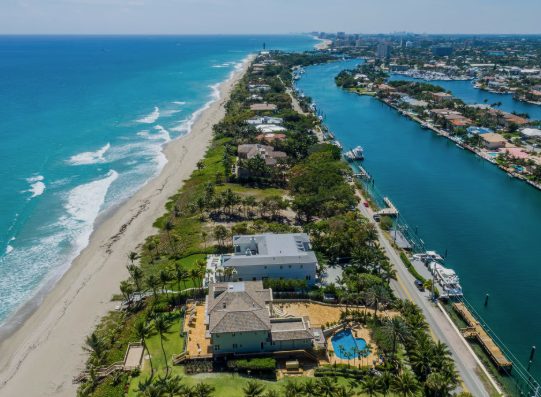
Hillsboro Beach is a barrier island town sandwiched between Deerfield Beach to the north and Lauderdale-by-the-Sea and Pompano Beach to the south, with the Hillsboro Inlet marking its southern tip. The town is almost entirely residential. There’s no commercial strip, no municipal downtown, and fewer than 2,000 full-time residents. What you get instead is a narrow strip of land with the Atlantic on one side and the Intracoastal Waterway on the other, lined with estate homes and a smaller collection of low-rise and mid-rise condo buildings.
Locally, the stretch of A1A running through here is part of what’s long been nicknamed “Millionaire’s Mile,” and that name isn’t marketing fluff. Lot values alone on the ocean side regularly start in the seven figures before anything is built. The town’s governance has intentionally kept density low for decades, which is exactly why it still feels like a quiet residential enclave instead of another high-rise canyon like you’d find a few miles south in Fort Lauderdale or Hollywood.
That restraint is deliberate, not accidental. Hillsboro Beach’s zoning has consistently favored estate lots and a small number of low-rise condo sites over the kind of vertical development that reshaped Fort Lauderdale Beach and Hollywood Beach over the last twenty years. There’s no height race here, no block after block of towers competing for ocean views. The town council has had every opportunity to allow that kind of growth and has not taken it, which is part of why land here holds value differently than it does in denser coastal markets. Scarcity isn’t a selling point someone invented for a listing description. It’s the actual zoning history.
Boating Is the Culture Here
Talk to anyone who’s lived on this stretch of A1A and the first thing they’ll bring up isn’t the beach, it’s the water access. The Hillsboro Inlet gives direct, no-fixed-bridge ocean access, which is a big deal for serious boat owners. That’s part of why you see private docks behind nearly every waterfront estate and why new luxury development here is being built around marina slips rather than just pool decks. If you own anything with real draft, Hillsboro Beach solves a problem that places further inland (anywhere you need the Intracoastal and a bridge schedule) never will.
For context on why that matters, think about what a boat owner in, say, Coral Springs or Plantation deals with. Getting to open water means navigating a chain of fixed and swing bridges, working around opening schedules, and adding real time to every trip out. A Hillsboro Beach address with inlet proximity cuts that friction to almost nothing. That’s a genuine, quantifiable value driver, not a lifestyle nicety, and it’s a big reason estate lots near the inlet carry a premium over otherwise comparable lots further up the Mile. Buyers shopping with a 50-foot sportfisher or a center console with real offshore range should treat inlet distance as seriously as they treat square footage.
Who Hillsboro Beach Actually Fits
Be honest with yourself before you fall in love with the drive down A1A. This town fits a specific kind of buyer, and it’s worth saying plainly who it’s not for.
It fits well if you are:
- An empty nester or retiree who wants waterfront living without the density of Fort Lauderdale Beach or Hollywood Beach
- A serious boater who wants deep water dockage and inlet access without a bridge in the way
- A privacy-focused buyer who doesn’t need (or want) restaurants, shops, or nightlife within walking distance
- A second home or investment buyer targeting ultra-luxury condo or estate inventory
It’s a poor fit if you are:
- A family prioritizing a top-rated zoned neighborhood school, since there isn’t one in town
- A first-time buyer or anyone working with a budget under $1 million for a single-family home
- Someone who wants a walkable town center, daily errands on foot, or a built-in sense of “downtown”
Put a face on those two lists and the fit becomes obvious fast. A retired couple selling a paid-off house in the Northeast, looking to put sale proceeds into a quiet, low-maintenance Intracoastal condo with a deeded slip for their boat, is a textbook Hillsboro Beach buyer. So is a Miami-Dade executive who wants a second home close enough for weekends but far enough from the density of Fort Lauderdale Beach to actually relax. On the other hand, a young family relocating from out of state with two school-age kids and a budget built around a 20 percent down payment on a $500,000 home is going to be frustrated here within a month. That buyer needs a zoned school, a Target within ten minutes, and neighbors with kids the same age. None of that is what this town offers.
If any of that second list describes you, you’re better served looking a few minutes south at Lauderdale-by-the-Sea, which gives you beach town walkability with a real commercial corridor, or at Lighthouse Point, which has the waterfront lot culture without Hillsboro’s price floor.
Price Reality by Home Type
This is the section most people skip straight to, so here’s the straight version, broken down by what you’re actually buying.
Single Family Estates on the Hillsboro Mile
This is the headline product. Direct oceanfront or deep water Intracoastal estates along A1A commonly start in the low $3 millions for older or smaller homes and run well past $20 million for newer construction with real dockage, pools, and square footage to match the lot. Teardown and rebuild lots alone can trade for seven figures before a shovel touches the ground. If your search engine keeps surfacing “Millionaire’s Mile” listings, this is the inventory it’s describing.
A practical way to think about pricing here: the land is almost always worth more than what’s sitting on it, unless the home is recent construction. A 1970s or 1980s one-story estate on a half-acre oceanfront lot is frequently purchased with the intent to demolish and rebuild, because the structure itself contributes very little to the sale price once you’re paying for linear feet of ocean frontage. Buyers coming from markets where the house drives the price need to recalibrate. Here, the dirt drives the price, and the house is almost a rounding error at the high end of the Mile.
Low-Rise and Mid-Rise Condos
This is where Hillsboro Beach becomes more approachable than people expect. There are a handful of older low-rise and mid-rise buildings, mostly on the Intracoastal side, dating to the 1970s and 1980s. Units in these buildings can still be found from the $300,000s to the $700,000s depending on size, view, and how recently the building has handled its reserves and any required structural recertification. These aren’t flashy, but they’re a legitimate way into the zip code without estate home money.
Think of this tier as the entry point for someone who wants the Hillsboro Beach mailing address and the lifestyle, but not the estate home price tag. A two-bedroom unit in one of the older Intracoastal buildings, priced in the $400,000s with a deeded dock slip, gives a retired couple or a downsizing second home buyer real deep water access at a fraction of what an oceanfront lot costs. The tradeoff is building age. Expect smaller floor plans, dated common areas in buildings that haven’t been renovated, and the need to look hard at the association’s financials before you commit.
New Construction Ultra-Luxury
At the top of the market, new construction is reshaping the town’s identity. The Rosewood Residences Hillsboro Beach project sits on nearly an acre of waterfront land with more than 1,200 combined linear feet of ocean and Intracoastal frontage, anchored by a private 14-slip deep water marina. The architecture comes from Arquitectonica, with wellness-focused interiors by Studio Piet Boon, and the penthouses carry private rooftop pools. Interior finishes lean into European wood cabinetry and the kind of spa-grade detailing that’s become the signature of branded ultra-luxury product up and down the Broward coastline. This is the clearest signal of where the top of the Hillsboro Beach market is heading: fewer, larger, more amenitized residences built around private marina access rather than density.
What makes a project like this different from a standard luxury condo tower isn’t just the finishes, it’s the business model behind it. A 14-slip private marina attached to a residential building means the buyer isn’t shopping for a unit with a nice view, they’re shopping for a lifestyle that includes guaranteed, deeded boat access steps from their front door. That’s an entirely different value proposition than anything you’ll find in a landlocked luxury building further inland, and it’s why branded residential projects with real marina infrastructure are commanding premiums that have little to do with square footage alone.
HOA and CDD Reality
There’s no blanket CDD across the town, but condo association dues on the older Intracoastal buildings can run noticeably higher than you’d expect for the unit price, largely because of insurance costs and structural reserve requirements that every coastal Broward building has had to take seriously since the post-Surfside reforms. Before you write an offer on any condo here, get the building’s reserve study and milestone inspection status in hand. That single document matters more to your real monthly cost than almost anything else in the listing.
Don’t treat this as boilerplate advice. In practice, two nearly identical units in two different Hillsboro Beach buildings can carry wildly different monthly costs once you account for a special assessment tied to a failed milestone inspection or an underfunded reserve account. A unit that looks like a bargain at $450,000 can end up costing more over five years than a $550,000 unit in a building that’s already fully funded its reserves and completed its structural recertification. Ask for the last two years of board meeting minutes along with the reserve study. If a special assessment is already being discussed, you want to know that before you’re under contract, not after.
Neighborhoods and What They’re Actually Known For
Hillsboro Beach isn’t big enough to have traditional “neighborhoods” the way Coconut Creek or Tamarac do, but there are distinct pockets worth knowing.
The Hillsboro Mile (Oceanside A1A)
The most recognizable stretch, lined with gated estate homes, several with private docks on the Intracoastal side of their lots even though the home itself faces the ocean. This is the trophy address end of the market. Lots here tend to run narrow and deep, stretching from the ocean to the Intracoastal, which is exactly why a single property can offer both a beachfront pool deck and a private dock for a serious yacht. That dual frontage is rare anywhere in Broward and is a big part of why these addresses hold their value even when broader South Florida luxury pricing cools off.
The Intracoastal / West Side
Quieter, slightly more accessible pricing, and home to most of the town’s condo buildings. Views here are of the Intracoastal and the mainland rather than open ocean, which is part of why pricing is softer, but you still get deep water and, in many buildings, private or deeded dockage. This side of the island tends to attract buyers who prioritize the boat over the beach view, since the dock slip and the Intracoastal sunset views matter more to them day to day than waking up to breaking waves.
Hillsboro Inlet / South End
The southern tip near the inlet and the historic Hillsboro Lighthouse is its own micro-pocket, prized by boaters for the most direct access to open water. The Hillsboro Club, a private oceanfront club, anchors this end socially for longtime residents. Properties closest to the inlet itself command a noticeable premium over otherwise comparable lots further north on the Mile, purely because of how much time that proximity saves a boat owner heading offshore or up toward Palm Beach County.
Schools: What Families Actually Need to Know
This is the part relocation buyers with kids need to hear straight: Hillsboro Beach has no schools inside town limits. There’s no elementary, middle, or high school zoned exclusively to the town because there isn’t enough residential density to support one. Families here are zoned into Broward County Public Schools and typically bus into schools in neighboring Pompano Beach or Deerfield Beach, depending on the exact address and current attendance boundaries, which you should always verify directly with Broward County Public Schools before buying since boundaries can shift.
In practice, most families who choose Hillsboro Beach and have school-age kids are already planning on private school. The corridor gives easy access to options like Pine Crest’s Fort Lauderdale and Boca Raton campuses and Westminster Academy, both within a reasonable drive north or south on A1A or I-95. Tuition at that tier typically runs into five figures annually per child, which is worth factoring into your true cost of living here alongside the home price itself. Families budgeting for Hillsboro Beach need to budget for private school tuition as a recurring cost, not a one-time decision, the same way they’d budget for a boat slip or a higher condo HOA.
If zoned public schools are a non-negotiable for your family, Hillsboro Beach probably isn’t your town, and that’s fine to admit early. Coconut Creek’s schools guide is a useful comparison point for what a strong zoned-school suburb actually looks like, since Hillsboro Beach was never built to compete on that metric.
Commute and Getting Around
A1A is the only real spine through town, running north-south the entire length of the island. There’s no direct highway access from within Hillsboro Beach itself, so getting to I-95 means driving off the island first, typically through Deerfield Beach to the north or Pompano Beach to the south.
Rough drive times from Hillsboro Beach:
- Fort Lauderdale-Hollywood International Airport: around 30 minutes depending on the bridge and A1A traffic
- Downtown Fort Lauderdale: 25 to 35 minutes
- Boca Raton (Mizner Park / downtown): 15 to 20 minutes north
- Pompano Beach’s commercial corridors: 10 to 15 minutes
Because there’s no public transit presence to speak of and no walkable commercial district, everyone here drives, and most residents treat the town itself as a retreat rather than a place to run daily errands. Groceries, banking, and everyday services happen in Pompano Beach, Deerfield Beach, or Lighthouse Point.
Worth factoring in if you work a traditional office schedule: the bridges along this stretch of A1A can add real variability to your commute, especially during peak boating season when openings are more frequent. Anyone commuting daily into Fort Lauderdale or Boca Raton for a 9am start should build in buffer time rather than assuming the drive times above are fixed. Weekends and holidays, when recreational boat traffic picks up, are the worst for bridge delays. If your job has any flexibility on start time, use it.
Lifestyle: What Living Here Is Actually Like
Day to day life in Hillsboro Beach is quiet by design. There’s beach access, but much of the oceanfront is private property attached to the estates, so this isn’t a town with a bustling public beach scene like Hollywood Beach or Lauderdale-by-the-Sea’s commercial strip. What you get instead is water, privacy, and low traffic.
The social center of gravity for longtime residents tends to be the private Hillsboro Club near the inlet, plus boating itself as a shared lifestyle activity. If you’re coming from an area with a built-in walkable Main Street, expect an adjustment period. Hillsboro Beach rewards people who already know they want quiet over convenience.
That adjustment period is real and worth planning for before closing, not after. If you’re relocating from a city neighborhood where you could walk to dinner, a coffee shop, or a gym, your routine here changes completely. Everything becomes a drive, even the small stuff. Residents who thrive here have usually already built a life around their boat, their home, and a short list of favorite spots in Pompano Beach or Lighthouse Point they’re happy to drive to. Residents who struggle here are usually the ones who underestimated how much they relied on being able to walk somewhere on a whim.
For buyers who want some of that same waterfront, low-density feel but with more commercial infrastructure nearby, Lighthouse Point is worth cross-shopping, and Hallandale Beach is worth a look if you want waterfront proximity with considerably more density and nightlife.
New Construction and Where the Market Is Headed
The biggest story in Hillsboro Beach right now is the shift from individual custom estate rebuilds toward large-scale, branded ultra-luxury development. Rosewood Residences Hillsboro Beach is the clearest example: nearly an acre of combined ocean and Intracoastal frontage, a private 14-slip marina, Arquitectonica architecture, and Piet Boon-designed interiors, with penthouse-level private rooftop pools. Projects like this put Hillsboro Beach in direct competition with name-brand luxury developments further south in places like Pompano Beach’s Waldorf Astoria Residences and Fort Lauderdale’s Bahia Mar St. Regis, as global hospitality brands continue moving capital into Broward’s coastline.
This is part of a broader pattern across the county, not an isolated Hillsboro Beach story. Broward is actively narrowing the historical luxury gap with Miami-Dade, and it’s doing it by offering lower density, competitive entry pricing relative to Miami’s top addresses, and maritime infrastructure that Miami-Dade’s denser coastline often can’t match lot for lot. High net worth buyers chasing amenitized residences anchored by deep water dockage and bridge-free ocean access are discovering that Broward’s barrier island towns, Hillsboro Beach chief among them, can deliver that combination better than almost anywhere in Miami-Dade.
What this means for buyers: the ceiling on Hillsboro Beach pricing is rising, and the town’s identity is consolidating around fewer, larger, more amenitized residences rather than more units. If you’re buying here as an investment or a long-term hold, that trend favors waterfront land and dockage access over anything landlocked or further from the inlet. A buyer weighing a dated Intracoastal condo against holding out for inventory in a project with real marina infrastructure should understand that the branded, marina-anchored product is where the long-term appreciation story is strongest, even if the entry price is considerably higher today.
Is Hillsboro Beach Right for You?
Here’s the honest bottom line. Hillsboro Beach makes sense if privacy, boating, and waterfront exclusivity are the actual priorities driving your move, and you’ve already made peace with driving for groceries and sending your kids to school outside town limits. It does not make sense if you’re chasing a walkable lifestyle, a strong zoned public school, or an entry-level price point.
If you’re relocating to South Florida and still comparing towns, it’s worth reading the broader Lauderdale-by-the-Sea guide for a walkable beach town alternative, or Tamarac if your priority has shifted from waterfront to value and family-friendly inland living. And if schools are the deciding factor for your family, start with the Coconut Creek schools guide and the related first-time buyer guide to Coconut Creek to see what a genuinely school-first suburb looks like compared to Hillsboro Beach’s privacy-first model.
Whatever you decide, don’t buy into Millionaire’s Mile because of the name on a listing. Buy into it because the lifestyle it actually offers, quiet, water-oriented, low density, private, is the lifestyle you’re genuinely looking for. If it is, there’s nowhere quite like it in Broward County.

Watch: learn more
Go deeper with my South Florida Insider videos.

The Best Flex-Space Townhome in West Palm Beach: Pulte's Nautical Plan

Inside Everton's Latitude II Model: $458k New Homes In Palm Beach
The Best Flex-Space Townhome in West Palm Beach: Pulte's Nautical Plan
More articles you might like
Hallandale Beach, Florida: The Complete Guide (2026)
18 min read
Deerfield Beach, Florida: The Complete Guide (2026)
18 min read
Is Avenir Worth It? An Honest Look at Multiple builders's Palm-Beach-Gardens Community
20 min readCost of Living in Palm Beach County in 2026: What Relocating Buyers Actually Pay
7 min readFirst-Time Buyer's Guide to Deerfield Beach, Florida (2026): Budgets, Loans, and Starter Neighborhoods
18 min read